IAVA -- Iraq And Afghanistan Veterans of America
[formerly: OPERATION TRUTH]
Founded in 2004 by an Iraq veteran, Iraq and Afghanistan Veterans of America (IAVA) is the first and largest organization for new veterans and their families, with nearly 300,000 members and supporters nationwide.
American servicemen and women have a voice that deserves to be heard; the issues and hardships troops face merit attention. Additionally, American troops have a distinct and important perspective that can influence the American political scene in a powerful way.
|
Operation Homecoming | NEA: National Endowment for the Arts
On September 12, 2006, the much-anticipated literary anthology Operation Homecoming: Iraq, Afghanistan, and the Home Front in the Words of U.S. Troops and Their Families, was published by Random House. Drawn from the acclaimed National Endowment for the Arts program and edited by the best-selling author Andrew Carroll, the anthology includes nearly 100 letters, poems, stories, and memoirs of service and sacrifice on the front lines and at home.
|
Veterans History Project -- Library of Congress
A Project of the American Folklife Center of the Library of Congress
The Veterans History Project of the American Folklife Center collects, preserves, and makes accessible the personal accounts of American war veterans so that future generations may hear directly from veterans and better understand the realities of war.
|
Wounded Warrior Project
Wounded Warrior Project® (WWP) serves veterans and service members who incurred a physical or mental injury, illness, or wound, co-incident to their military service on or after September 11, 2001 and their families.
|
Operation Recovery | Iraq Veterans Against The War
A Campaign to Stop the Deployment of Traumitized Troops.
Service members who experience PTSD, TBI, MST, and combat stress have the right to exit the traumatic situation and receive immediate support, and compensation.
|
PTSD Foundation of America
Providing Hope and Healing for the Unseen Wounds of War
|
Make The Connection -- Veteran Stories & Support
Connecting Veterans and their friends and family members with information, resources, and solutions to issues affecting their health, well-being, and everyday lives.
VetFriends Military & Veteran Search | Helping U.S. Military Veterans Reconnect
|
| Operation Baghdad Pups | SPCAI
Aid for Relocating Military Pets: Military.com
|

State Veterans Affairs Offices
Global Digest has a section on USA Veterans.
|
|
|
|
|
|
|
A Global Digest For The 21st Century
Politics | Society | Culture | Economics | Environment
 Purpose
My original motivation for developing this information and discovery resource was to attempt to assemble, in one place, a broad panorama of the players, problems and issues affecting the world community. It has been and continues to be a singular learning experience.
I first began working on this during the winter and spring of 2000-2001. Very little of what I was discovering was being given common media talk or even the occasional 'special feature' status, except, perhaps, once in awhile you might see a documentary on TV or read an expose in a magazine or national newspaper.
But on 9/11/01, the out there world became not only here but everywhere. Afterwards I realized that this personal research project had suddenly become relevant and could possibly be useful as a means towards a broader understanding of what's going on in the world.
 A Global Digest utilizes the nature, architecture, and mode of the WEB to consolidate the social forces of world activity in a single location, presenting the main intertwining threads as a picture of the world taken as a whole.
This Page is currently (03/14/14) close to one meg, so, if you'd first like to view the Table of Contents before diving in, retrieve this brief file.
|
|
|
|
|
"The Superposed Self"
[Originally: "The Geometry of Freedom"]
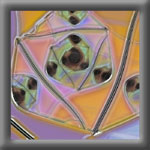 The boundary, or surface, of any figure of any dimension represents the limit of what may otherwise be considered unlimited [The two end-points of a one-dimensional line segment are its boundary, for instance.]. This limit acts to give definition to the unconditioned.
For example, the infinite 2-dimensional plane can have embedded in it a closed path of any imaginable design: a circle, a square, a pentagon, plus completely irregular shapes. When done, unlimited factored by limit [unlimited/limit] takes on a unique identity, in time and space.
A 3-dimensional solid ball or sphere is contained by its 2-dimensional curved surface or boundary. If we think of this ball as a collection of free-floating atoms or molecules, its surface, necessarily, is composed of these interior elements; nonetheless, it has an identity all its own by virtue of its special role as limiter, separating the inside from the out.
Increasing the dimension of the interior to the fourth, we can talk about, although not properly imagine, a 3-dimensional surface, a surface of a hypersphere of four dimensions. In this context, instead of free-floating molecules, we consider the homology group of all living things. We can define the individuality of these separate 3-D living objects by their boundaries, that which stands out from, or emerges from, the group of all possible cycles or waves of matter, their state of superposition. These cycles, or closed chains of vertices, give expression to the fourth dimension, wherein the elements of the class of all living things are essentially connected and undifferentiated.
|
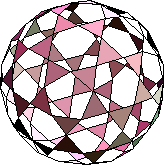 A simplicial complex (to be defined later) may be thought of as the rational reflection of differentiated images perceived by the brain as it attempts to sort out its surroundings. This complex 'rests' on the surface of reality, mapping it, and this surface, or boundary, although of the underlying spacetime itself, nonetheless has a reality all its own, separating, as it does, interior from exterior.
Similarly, the boundary of all living things emerges transcendent and is itself, by nature, unbounded [as the 2-D surface of a 3-D ball is unbounded, being a boundary in its own right], part interior, without which it would have no being or manifestation, and part exterior, without which it would have no meaning or identity. It would thus seem to be a mixture, an alloy, a blending of immanence and transcendence and of being and non-being. A three-dimensional membrane of consciousness [the physical realm considered as the "densest medium"] 'enwrapping' a four-dimensional unconscious reality.
[It is my personal belief that all living things possess some degree of consciousness by virtue of being alive. It is inherent in the universe itself, and, therefore, all living things are expressions of this and partake of it.]
 The human being reflects or expresses this idea. As grain in wood we represent the same idealized pattern, the same archetype, indelibly etched into our cosmic genes. Our psyche functions through the tension effected by the interplay of the conscious/unconscious dichotomy. On the one hand, content fills the agent of order as raw material upwells from within. And on the other, Mind, enclosing and interpenetrating from without, filters through the interface separating individual conscious ego from universal unconscious reality, the great sea of creativity. By so doing, we consciousize the Unconscious as we identify with it.
The psyche comes from Deep Time, from the beginning--perhaps it originated with the Big Bang. It is an eidetic accumulator of impressions, stamped with the inner structure of the Void itself, bringing into manifestation the warp and woof of the cosmos.
Length: If printed out on 8.5-by-11-inch paper, it would be approximately 100 pages.
|
 "The Superposed Self" draws ideas and concepts from various mathematical fields, such as: Algebraic [or Combinatorial] Topology [Group Theory applied to the topology of polyhedra]; Linear Algebra [Transformations, represented by matrices, defining orientations on Vector Spaces]; and, acting as the overall frame, Modern Algebra [the study of Groups and other algebraic structures (ultimately the study of symmetry)].
The basic paradigm has to do with the recognition of a hierarchy of essential identities as being the result of a factoring process--whether of the physical realm or of the psychic--in the act of self-identity. Each factor --progressing as a geometric series towards increasing complexity--is stamped with a unique pattern--a kernel of identity--by its immediate parent structure in the act of factoring. The parent elements are thereby grouped together [essentially a re-grouping] according to the rule stipulated by the kernel. The effect is an identity-pattern that resonates through to the surface where it interfaces and interacts with its surroundings. However, the expression of this self/kernel is ultimately limited by what is possible.
The Composition Series
G = H0, H0/H1, H1/H2, H2/H3,..., Hn-1/Hn, Hn = {e} - the identity element;
Hnis the maximal normal subgroup of Hn-1 for all n,
and all factor groups are simple; that is, nondivisible and invariant.
Imagine a light shining through a window covered with a symmetrically organized collection of dots. The light maps these dots to a screen through a magical intervening filter (a linear transformation) that repositions the dots and places them into certain associations called equivalence classes--elements of the factor group. [Example]
Furthermore, as each identity (our filter from above) is a sub-symmetry contained within the pattern of the parent, an inheritance of form is transferred. Each kernel--identity element of the factor group--dictates how the dots are to associate, thereby reorchestrating the overall design of the parent in its own image, and in the process, establishing new initial conditions--a new parent--for the next phase transition.
Themes include: properties of pattern, relationship, and symmetry, with respect to perception, consciousness, and individual identity.
It is composed of three essays, each of which is a separate HTML document.
"The domain of species are invariant subsets and there are partitions of these sets that define genera, families, and so on, corresponding to hierarchically related invariant subsets."
From: How The Leopard Changed Its Spots, page 113, by Brian Goodwin.
|

Thomas Adrian Dorn
[Dissertation begun in the mid-80's,
finally rewritten and completed 2004.]
|
|
|
| It's common knowledge that there's an overwhelming amount of "stuff" on the Internet/Web, some of it worthwhile and helpful; most, not. This site is an attempt to skim the cream, and, as such, is selective, rather than comprehensive. I hope you find it useful.
Main Topics
Medical/Health, Astronomy, Biology, Physics, Chemistry,
Geosciences, Mathematics, Government, Arts
|
|
|
 "So you think you're tough, do ya'?"
|
|
|
|
The Story Of Donald
From the Great Library on the planet Xulcator
Keepers of all Knowledge and Legends in the Galaxy.
(or at least they try to)
Translated by Adrian Dorn
*************
The subcutaneous resonator fluctuated through the transition phase as it passed the 8000 degree Kelvin mark. Agitated electric fissures of black and orange coursed the containment field, chasing one another like snakes in a feeding frenzy. The intense pressure rose and settled as the robot modulator stretched the porous core to absorb tachyon residue.
Donald, the overlord technician of Beta colony, thought it was a good time to step outside for a smoke. The constellations over Aurelius always disoriented him. He would never get used to it, he thought, as he lit the cannabis tube and took a long, deep drag. The teraforming operation had been going on for two full years, continuously, and yet the air was still only 38% the density of Earth's. The pills helped, supplementing what was lacking. When his job was done, they would no longer be needed, but then it would be time to move on to the next colony farther out. He cursed under his breath; he never got a chance to enjoy the fruits of his labor.
Suddenly, the muffled reverberation of alarm bells could be felt through the vinyl-foam body suit. With shock and dismay, he realized he'd lost track of time and strayed too far in his daydreaming under the alien sky to reach the shut-off switch before meltdown. Earlier he had dismantled the automatic, waiting, as usual, for parts from Earth. Too late. An overload was imminent. The exterior building would turn to plasma and collapse. He ran, fast. It was all he could do. But not towards the overheating resonator, but away, away towards the shelter of the bunker on the other side of the twenty-foot berm of rock and dirt.
Tears streamed his cheeks as he listened through the thin atmosphere to the shrill tearing sound of electrons being stripped away from the steel-reinforced melodidium. He knew he'd be fired and have to return to the nightmare called Earth. He ran, crying, wanting to die.
*************
CONTINUED...
*************
|
|
|
Physics: Causal Dynamical Triangulations
[Based on Algebraic Topology, in particular, Simplicial Complexes composed of differential-sized planar elements
-- n-D oriented-simplexes (simplices) -- collectively generating a manifold → spacetime.]
The Universe From Scratch
PDF Download available authors: R. Loll, J. Ambjorn, J. Jurkiewicz
"A fascinating and deep question about nature is what one would see
if one could probe space and time at smaller and smaller distances."
Causal Dynamical Triangulations and the Quest for Quantum Gravity
From arXiv Repository | PDF download available - submitted April 2, 2010
"It is the only approach to have demonstrated that a classical universe
can be generated dynamically from Planckian quantum fluctuations."
Background Geometry in 4-D Causal Dynamical Triangulations
PDF File - June 17, 2008 | by Andrzej Gorlich -- Institute of Physics, Jagiellonian University, Krakow
Nonperturbative Quantum Gravity | PDF File | Authors: J. Ambjorn, A. Goerlich, J. Jurkiewicz, R. Loll
Quantum Gravity, or The Art of Building Spacetime
From arXiv Preprint Repository | PDF download available | submitted April 28, 2006
Renate Loll's Home Page
J.Ambjorn -- Niels Bohr Institute - University of Copenhagen
Jerzy Jurkiewicz -- Department of Phyiscs - Jagiellonian University
Focus: Deriving Dimensions [Brief Article by Adrian Cho]
Physical Review - APS: American Physical Society - September 28, 2004
"New calculations show how the four dimensions we take for granted emerge from the “quantum foam” of spacetime."
Quantum Gravity via Causal Dynamical Triangulations
From arXiv Repositiory | PDF download available | Authors: J. Ambjorn, A. Goerlich, J. Jurkiewicz, R. Loll
The Self-Organizing Quantum Universe
PDF file | Authors: Jan Ambjørn, Jerzy Jurkiewicz and Renate Loll
"This approach shows how four-dimensional spacetime as we know it can emerge dynamically from more basic ingredients. It also suggests that spacetime shades from a smooth arena to a funky fractal on small scales." -- The Editors
Fixing the Boundaries for Causal Dynamical Triangulations In 2+1 Dimensions
PDF File | by Jonah Miller - Department of Physics - University of Colorado, Boulder
Renate Loll - Perimeter Institute
*************
|
|
|
|
|
|
|
MANIFOLD
This came to me in a dream: I saw space fractured into a zillion pieces. And not just random shards laying on the ground like a smashed crystal wine glass, no, they were ordered, all the diverse sizes and shapes imaginable intricately arranged.
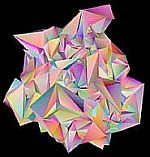 The idea of a simplex is easy to visualize. They're dimensional. A 2-simplex can be thought of as a closed triangle with three vertices and three line segments -- or edges -- acting as its boundaries connecting the vertices. But, topologically, it can take any cell-shape, a cell being a generalization of a simplex. Each cell is homeomorphic -- maps invariants to invariants -- to a Euclidean space. In that sense, they resemble a manifold. Now, the term manifold is oftentimes generalized to mean any flat surface, but its significance lies in the fact that compared to a polyhedron, it is all of one piece. It has no sub-partitions joined together as does a polyhedron. In that manner, each manifold corresponds to a local flat Euclidean plane.
So we have simplex equals cell equals manifold. By the use of barycentric coordinates we can further sub-divide the cell into simple quotient spaces to create a polyhedron of space. With each factoring we create a composition series, further refining the cell's detail. The cell, it may be pointed out, is susceptible to continuous deformations. In the process its interior morphology rearranges its play of symmetries in a dynamic and self-organizing manner. And as the interior of a cell is sensivitve to its boundary shape, it is said to be shape-aware, analogous in regulatory capacity or methodology to the morphogenetic field of a biological cell. An important point that shouldn't be underestimated concerns the orientation -- spin -- imposed on a simplex, infusing it with a causal asymmetric tendency effecting ripples and contours. This feature eliminates random inconsistencies.
→ Click image to the right for larger version
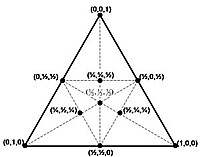 A change of basis takes place; we zoom in. Barycentric coordinates expand the vertices onto a smaller, more refined scale, adding degrees of freedom, revealing underlying dimensions. As the space grows in complexity, each vertex, boundary and interior point transforms into a linear combination -- weighted by the barycentric coordinates acting as coefficients -- of the newly defined vertices. Essentially, the original coordinate system is relabeled. Also, any number of lines can be drawn through the interior of our cell, intersecting an edge at a point. For instance, for the triangle or 2-D simplex, a line can be drawn from each vertex to a point on its opposite side (edge), this point is then written in terms of the basis of three weighted vectors -- our barycentric-ized vertices:
point = a1v1 + a2v2 + a3v3.
So let each cell of any particular dimension be increasingly refined with lines drawn to points along its edges, further dissecting and contorting its volume, further detailing the enclosed (convex) compacted space. The areas and volumes of faces and simplices of our complex, it should be pointed out, are quantized according to elementary Planck units. Lines of partition [field lines, if you will] intersect at the center of mass -- the source point of the cell. Individual particles of matter and radiation are thus created.
For example, an electron can correspond to a factored network of quotient spaces in a fluctuating state, stuck in a loop due to the particular configuration, compressed into a bounded condition. Increasing and decreasing refinement within a certain range corresponds to its everchanging position and momentum. As the space of that cell increases in detail due to fluctuating factoring, a photon is absorbed. As it decreases, a photon is expelled. This represents a probability distribution as a result of, or corresponding to, the quantum partitioning. The electron can be localized by the barycentroid (or multiple barycentroids) of the cell, insensitive to noise and deformations.
Looking at our cell-complex from another perspective, continually varying spatial vortices collectively forming an ever-shifting strange attractor, an emergent phenomenon, manifests in the macro-world as spacetime, the fabric of it, to use a hackneyed mataphor. Piecewise, a strange attractor renders the overall appearance of the cell as it goes through its fluctuations, fractalizing space. A collection of these cells (simplex, node), interfacing at their boundaries (face, surface), on any required dimension, induces neighboring individual -- quantum level -- cells to arrange their interior structures in sympatico, either by means of extensions of partitioning lines from the source point crossing respective boundaries, or through resonation of sub-vortical frequencies.
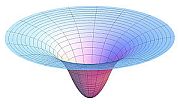 Think of a cone made from a sheet of paper as you twist its pointed-end tighter and tighter. That is the space, or the simplicial complex, of gravity, barycentric coordinates standing for centers of mass [barycenter means center of mass or gravity]. Space, taffy-like, creates the surface appearance of curvature due to its contraction and stretching, to its folding and squeezing. The underlying cause may be attributed to the increasing refinement -- or factoring -- of the sections of simple quotient spaces -- factor groups of denser symmetry -- spontaneously generating, and nested in a hierarchy of sub-domains. Three-dimensionally, we can think of a tetrahedron as homeomorphic to a solid ball, an image that seems to be more agreeable for its natural symbol of centering.
Onion-skin slices superimposed on one another, interconnected and interrelating, subject to positive amplification and negative feedback constraints. Layers of spacetime embedded within each other -- concentric spheres -- yet separable along an imaginary axis. Viscosity thickening towards the bottom or center, bubbling up new micro-states from nano-moment to nano-moment, evolving fresh pseudo-stable surfaces through some kind of force convection.
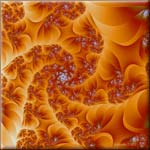 Simple refers to non-divisibility. Each factor group -- each sub-domain of compacted space -- is a whole unto itself, locked in a preferred arrangement or quantized set of arrangements. The mesh size of any specific simplex net varies relatively, but must be no greater than a suitable Planck designation or limit based on the compact nature of the associated Lie group in Hilbert Space. An appropriate distance-metric can be imposed from without but understood only as an artifact for purposes of calculation. Being topological, the underlying field has no inherent metric; in a topological space distance has no meaning. Objects exist in and of themselves without reference to any background coordinate system.
Furthermore, thinking of space as a fluid medium allows us to forgo the associated notions of rigidity and flatness of space inherent in our concept of manifold. It bends and twists and can reform into any conceivable topologically valid shape. Time and motion are thus seen as effects of this constant partitioning. Particles as constricted loops, trapped in a web of symmetrically bound energy. Forces as changes in the loop structure due to fluctuation of the spatial components -- the factors.
It's the energy of the Void itself that intiates this creative endeavor.
As John D. Barrow writes: "Space and time can be born and thus can die."
|
|
|
|
|
|
The Day I Died
It's not easy for me to take corporeal form. I can only do it for a brief period of time; the energy outlay is enormous. But I'll try to maintain stasis for as long as possible so I can tell you what I've discovered. Two hundred and fifty seven years ago, I died, or at least it seemed so. Let me attempt to recount the events leading up to it, and those that followed.
 I awoke that morning later than usual; the ramifications of copious amounts of champaigne rumbling through my head like a herd of elephants. An artist friend had fortunately established himself in the real world; after years of struggling with low-rent galleries, a well-known critic finally touted his paintings. Only days after the review appeared in the paper he was contacted by the owner of an upscale gallery, one where people actually bought works instead of just looking and leaving, eating the cheese and drinking the wine. I've done that, many a time, it's a way to spend a sunday with a lady friend. Yesterday, or the previous day, to be more accurate, was the first of his showings -- to last two weeks. So, a celebration was in order.
Tea helped bring me back to some semblance of life, although, strangely, my mind seemed rather clear, almost sharp. Heavy socializing often had this effect after the doldrums of aloneness. Too much time spent thinking is not good for you. Curiously, while having tea in the garden, I found myself reading a yellowed pamphlet I discovered -- hidden in my bookcase -- on Blaise Pascal's speculation that a vacuum existed above the atmosphere -- in outer space, no less. I had no idea what to make of it. How could he know? In the midst of pondering this I left my apartment and proceeded to breakfast, clearing my head in the doing, with an old friend of university days, or at least, I thought he was, at that time.
We'd bumped into one another the previous evening as I left Marie's salon west of the canal. It was drizzling so we both had our heads bowed and almost collided right there on the street. It was far too miserable to chat, and I was far too drunk, so we arranged to meet at Cafe Leboeuf, my favorite retreat. As I walked, thoughts of the vacuum of space gave over
 to thoughts of this friend from school. Just as suddenly I found myself entertaining a shadow of doubt brought on by the murkiness of aged memory; it had been years ago, after all. Had he really been a friend? How close? Or had we only shared a few classes together, the familiarity of a face from that richer and happier period in my life giving our relationship an unwarranted significance?
As I crossed streets and navigated absently through carriages and people, I ransacked my brain for proof, a single shred of experiential evidence to corroborate my inclination. He certainly considered us friends and remembered me almost instantly. In fact, it'd been on his insistence that I willingly -- out of loneliness? -- concurred. My emotional state had been rather dry for some time, perhaps I was merely wishing it to be true.
***************************
CONTINUED.....
***************************
|
|
|
|
|
| Astronomy
|
For more Astronomy websites, go to the NASA/Astronomy Page in the library.
NASA Comet ISON Observing Campaign | November, 2013
Comet ISON's Current Status
As we gaze into our crystal ball | The Future of ISON
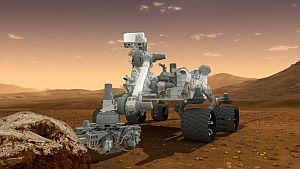 NASA: Mars Science Laboratory, the Next Mars Rover - 'Curiosity'
Video Gallery
Mars Science Laboratory - Curiosity Rover
Exoplanet Exploration
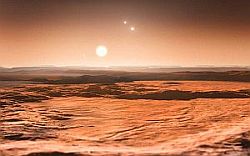 Three Potentially Habitable Planets Found Orbiting Gliese 667C
By Nancy Atkinson - June 25, 2013 | Universe Today
Three planets in habitable zone of nearby star: Gliese 667
Astronomy News - June 25, 2013
Another Earth Just Twelve Light-Years Away?
ScienceNOW - December, 2012
The Extrasolar Planets Encyclopedia
Planet Quest: New World Atlas
The New Worlds Atlas is a continuously updated database of all planets
that have been discovered around stars other than the Sun.
Planetquest: Timeline
Near Earth Objects -- NASA
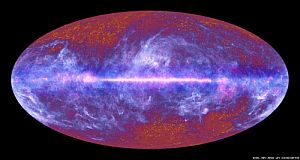
NASA -- Planck
A European Space Agency Mission with NASA Participation
ESA Science & Technology: Planck Mission Home
BBC News: Planck Telescope reveals ancient cosmic light
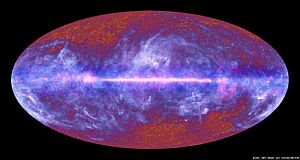
"Planck Spacecraft Reveals Unseen Galaxies"
Scientists release first taste of data from Planck mission
January 11, 2011
|
| Hubblesite
Star Collection
The Chandra X-ray Observatory Center
NASA's Chandra Sees Brightest Supernova Ever 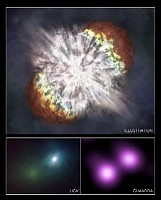
SN 2006gy
DARK ENERGY FOUND STIFLING GROWTH IN UNIVERSE
Astronomers Discover Largest Star On Record
The Largest Galaxy in the Universe: IC 1101 | VIDEO
12/05/11: NASA's Kepler Confirms Its First Planet In Habitable Zone
Dec. 7, 2011: First Habitable Planet Discovered
Astronomy Picture of the Day
GALAXY ZOO
Hickson Compact Galaxy Groups
Hayden Planetarium
The Known Universe -- VIDEO: 6:31
LHC -- Welcome to the Large Hadron Collider
where Cosmology and Particle Physics merge -- literally
Universe | Alexandria Digital Library
History of Astronomy
University of California, San Diego -- Center for Astrophysics & Space Sciences
Windows to the Universe
Brought to you by the National Earth Science Association
An Atlas of the Universe
The Milky Way Galaxy
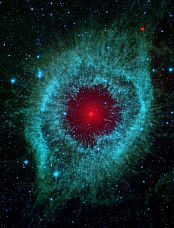 A Review of the Universe
Table of Contents
General Index
Quantum Foam and Loop Quantum Gravity
Quantum Field Theory
Universe Today
How Many Moons are in the Solar System?
Open Questions: Physics and Astronomy
"A place for everyone to explore on the frontiers of science."
Cosmos Portal
"The Cosmos Portal is a gateway on the Web to astronomy and space science."
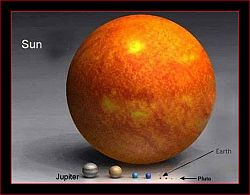 Living Reviews
"Living Reviews are scientific open access journals, publishing review articles
that provide insightful surveys on research progress in the fields they cover,
and guiding readers to the most important literature in the field."
COSMOS Magazine | the science of everything
Science News
Magazine of the Society for Science & the Public
SpaceRef -- Space News as it Happens
Planck Mission Peels Back Layers of the Universe
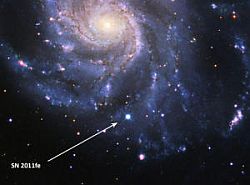 Science Daily
Unusual Supernova is Doubly Unusual for Being Perfectly Normal | August, 2011
Discovering A New Earth 430 Light Years Away | April 1, 2008
Earth and Moon Formed Later Than Previously Thought
The Worlds of David Darling
The Internet Encyclopedia of Science
Cosmology and Astrophysics E-Print Archive
Measurement of the neutrino velocity with the OPERA detector in the CNGS beam
-- PDF File, 4.65megs
Encyclopedia of Astronomy and Astrophysics
This unique resource covers the entire field of astronomy and astrophysics
and this online version includes the full text of over 2,750 articles,
plus sophisticated search and retrieval functionality,
links to the primary literature, and is frequently updated with new material.

Globular Star Cluster Omega Centauri & Other Star Clusters | Hubblesite Newscenter
**************************
|
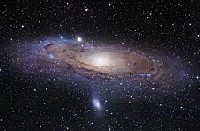 Astrophotography
by Robert Gendler
|
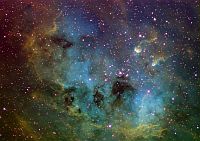
Astrophotography
by Bob Franke
|
|
Earth Life Likely Came From Mars
August 28, 2013 - Space.com
Maybe Mars Seeded Earth's Life, Maybe It Didn't
August 29, 2013 - Scientific American Blog
'We are all Martians': Chemist's otherworldly claim stirs debate
August 28, 2013 - NBC News
|
|
|
|
|
|
Nomad
His back was ruined from digging post holes, a condition he'd grown accustomed to. And his hands were a mess. He had little experience working with barbed wire and they paid the price. He thought of this job as his last, his very last. Age and a painful weariness from having to deal with people had brought him to this place in his mind. He could tolerate certain folks for brief periods of time, but did not seek them out; socializing was not his habit. When the boss threw parties at the ranch, he never attended, always finding an excuse to go out on the range, to fix something needed fixing. He was quiet and left to himself by the rest of the crew. The younger ones made fun of him, sometimes to his face. He'd just snicker, shake his head and walk off. The older ones, closer to his age, would warn them: Don't poke a bear with a sharp stick. But, being young and full of themselves, they'd laugh it off.
 It was getting towards evening, the light clouds filtering the waning daylight. He'd had enough, anyway. Saddling his horse he rode due west for the ranch and the comfort of his bunk. He barely had the strength to remove his boots, then fell quickly to sleep. The dinner bell would wake him. The rest of the men milled about, coming and going, ignoring his presence as they always did. His bunk was over in the far corner, away from the others. He hid a bottle of whiskey in his duffel under the bunk, but none had ever seen him drink. Nor had any ever seen him drunk. After dinner, he'd sit outside on the toprail of the corral smoking. That seemed to be his one pleasure in life.
He'd been working at the Circle 'M' Ranch for close to three months. As with all new arrivals, the others asked many probing questions, wanting to know just who they were sharing their lives with, and who might be a danger to them. He was vague about where he came from and what he'd been up to. Vague to the point of secretive. After awhile, the men gave up, believing, at least, he was no threat. Pretty much all they knew, and all they needed to know from his perspective, was his name. He called himself Nomad, the name given him long ago by a gypsy woman. He liked it so it stuck.
The day wore on in typical fashion. It was getting close to July 4th and the boss always held a big party. At dinner, the men talked of nothing else. They spoke of the fireworks and food and what musicians were coming, but mostly about the other ranch women, and especially those from town. The signs of fights over certain ones already brewed from the sound of their talk, and it would only get more intense as the day grew closer. Nomad ate in silence. Such conversation bored him, he'd heard it all before in a hundred towns, in hundreds of bars. The men could fight to the point of death, it mattered not, it was always up to the woman to decide in the end.
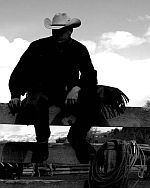 Afterwards he retired to his rail by the corral, studying the horses as they walked and occasionally galloped from one end to the other. A curiosity he never could fathom. Flies, maybe; or just the sudden urge to be let out to run, to be free on the high range where they came from. Breathing the cool crisp air off the ridge instead of down here in the dry dust working for meals.
Life had shifted gears some time in the distant past for him as well. In spite of himself, his mind would always fall into that hole, a roullette ball finding home. He sat and smoked and watched the horses -- and thought.
Xavier, the Mexican cook, climbed the rails and sat beside him. He was the only one Nomad bothered with. He played dumb, mostly because the crew expected him to, but Nomad could see he was far from it. Xavier hedged a question, "How goes it, amigo? You see anything in that crystal ball you're always gazing into?"
Nomad spat, then forced a smile, "Nah. It's the same story over and over. I keep looking for a break in the action, but there isn't one. It goes all the way through to the bottom, and stops dead."
"Maybe you should try sitting on another rail."
"Might work. But then, the horses wouldn't recognize me."
"Re-introduce yourself, change your name."
"You mean, start at the bottom and work up?"
Their conversations usually went this way. It seemed to make sense to them, but any of the others eavesdropping had no idea what they were talking about.
The next morning Nomad was scheduled to go into town with two of the younger ones, take the wagon and get supplies for the upcoming bash. The cargo would include whiskey, which would be held under lock and key by the foreman, a tough bastard of no nonsense disposition who knew firmly on which side his bread was buttered.
**********************
To Be Continued...
**********************
|
|
|
The Unusual
|
Honey Possum
Enchanted Learning
Reza Sarhangi, Professor of Mathematics
Haiku Society of America Online Haiku Collections
Windows to the Universe
Brought to you by the National Earth Science Association
BOOK FOR PAINTING -- free project for kids
Carol WhiteWater Dawn's Homepage
What is a Dreamwalker?
Subtlebody-Images: Music
The Function of the Human Brain
Photo Galleries -- Photos of Asia, Europe and Africa
Myanmar/Burma Photo Gallery
Grace Galleries -- Rare Old Antique Maps & Sea Charts
Panoramio -- Photos of the World
Well done and worth the time
Encyclopedia Smithsonian
Encyclopedia Smithsonian: Entomology
The Online Literature Library
Above Australia -- Aerial Photo Library of Australia
Molecules and Meaning: How Do Molecules Become Biochemical Signals?
What's Your Sign? -- Discover the world of symbolic meanings
Scorpio Tales
Edge: Conversations on the Edge of Human Knowledge
Changing Minds
New Dawn Magazine -- Ancient Wisdom, New Thinking
Schuelers Online
Mystic Eye Tarot Symbols Glossary
Myths, Dreams, Symbols -- The Psychology of Dreams
Myths, Dreams, Symbols -- Jung's Concept of the Psyche
Carl Jung Resources
Human Flower Project
Picsearch -- more than 3,000,000,000 pictures.
ISCS: The Institute for the Study of Complex Systems
The Emergent Universe -- Interactive
Stanford Encyclopedia of Philosophy
Stanford Encyclopedia of Philosophy: Emergent Properties
Genomic Medicine -- A Primer -- NEJM
Introduction to Molecular Biology Information Resources
Regent University -- Writing Center -- Resources
The Quote Garden: Quotes, Sayings, Verses
Symbol Meaning for Hundreds of Symbols & Symbol Resources
Patrick Woodroffe: AUTHOR, POET, PAINTER & SCULPTOR
Patrick Woodroffe: Gallery & Images Page
Buzzle Web Portal: Intelligent Life On The Web
Buzzle Web Portal: Deforestation
Complex, multicellular life from over two billion years ago discovered
John Baez's Stuff
A Brief History of the Universe
Hypertextbook.com
The Physics Factbook: Topic Index
The Physics Hypertextbook
HyperPhysics Concepts
Spacetime, Einstein's Relativity, Space, Time, Quantum Gravity, etc.
Beyond Quantum Theory
|
Brains and Climate: William H. Calvin
Through the Wormhole | Watch Free Documentary Online
Hosted by Morgan Freeman
Wildlife Photography in Siberia and Central Asia -- Oleg Kosterin
Big Cats, Facts, Information, Photos -- National Geographic
MrNussbaum.com -- A Thousand Sites in One
Reason and Intuition -- Ian Heath
EyeWitness to History -- history through the eyes of those who lived it
Folktexts: A library of folktales, folklore, fairy tales and mythology
Literary Genres: General List -- PDF File
Latitude and Longitude of World Cities
Animal Photos -- LOTS!
India Nature Watch
India Nature Watch: Mammals
George P. Landow: Home Page
Websites Created and Managed by George P. Landow
Fact Monster: Almanac, Dictionary, Encyclopedia, Homework Help
Geography Homework Help for Kids -- by Mandy Barrow
Math and Science sections, spectacular photos, and much more...
The Noble Pagan
Native American Terms -- Totem, Amulet, Talisman
Symbols & Meanings
Pegasos -- Literature related resources
Authors' Calendar -- Index of Authors
Dream Dictionary | SmartGirl
Symboldictionary.net -- A Visual Glossary
Spiral Nature
Symbols.com -- Online Encyclopedia of Western Signs and Ideograms
Ancient Symbols -- Meanings of Symbols from Ancient Egyptian, Celtic, Greek, etc.
Chinese Poetry
Elainesheartsong -- Beautiful paintings -- colors
Sprott's Fractal Gallery
The Big Bloom -- How Flowering Plants Changed The World
The Elements of Style by William Strunk, Jr. -- Full Text
UW Madison Writing Center
Clipart ETC. Free Educational Illustrations For Classroom Use
An Online Service of Florida's Educational Technology Clearinghouse.
Grammar Workout Menu
Grammar Bytes! Grammar Instruction with Attitude
History of Life Web Links
Evolution Links -- Prof. Eernisse
World Wide Words
Michael Quinion writes on international English from a British Viewpoint.
Internet Encyclopedia of Philosophy
A Peer-Reviewed Academic Resource
Stanford Encyclopedia of Philosophy
Being and Becoming
Western Philosophy
Process Thought and the Hopi Universe
Art Through Time: A Global View
Art Through Time: A Global View -- Transcript for Writing
Writing: Overview and Video
Guide to Grammar and Writing
Free Dictionaries Project
Encyclopedia
Visual Dictionary Online -- Merriam Webster
|
|
|
TIME
there is a dynamic to the Present
set in motion
by
infinitesimally tiny disequilibrium perturbations
nonlinearly orchestrating the Time-field
Light-Time is stratified
forcibly stretched
repelled elastically
along continuous spokes
emanating
from
No-Time
Time-field is made manifest through this mutual
INTERPLAY
and
TENSION
|
|
|
|
|
TIME ZONE
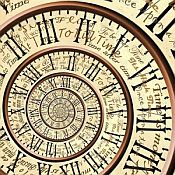 Lately there seems to be a convergence of minds -- physicists and philosophers -- centered around the question of the validity of the time concept. Things are coming to a head. This month's (June, 2010) issue of Scientific American has as its lead story: Does TIME Really Exist? by the University of California, San Diego philosophy professor, Craig Callender [funny, his name's Callender and he's writing about time]. Mathematician John D. Barrow writes in his book PI In The Sky "Spacetime is but a large-scale manifestation of some more fundamental entity." From what I've read, this seems to be the general consensus.
The essay contest of June, 2008 offered by FQXi on The Nature of Time drew a lot of attention from the world's TIME enthusiasts. The times they are a-changing, or that is to say, the notion of time is undergoing severe scrutiny. As Einstein examined our assumption about time's nature and overthrew its Newtonian hold on our psyches, a similar questioning is currently going on. There is no definite understanding as to the origin or essential characteristics of time. The rush to derive a comprehensive theory of gravity towards a hoped-for unified field theory to replace or supplement the Standard Theory has to stop to take a breath, back-up, so to speak, in order to first address this major conceptual hurdle. What exactly is time?
Almost forty years ago I was living in Santa Monica. One day I wondered into a used book store, my favorite places to explore. Way back in a far corner I came across a little yellow hardback book entitled Fingers Pointing Towards The Moon by Wei Wu Wei. I still have it. At the time, I was looking for something to grab onto, as a guide of sorts, some line or course that cut through the trappings of religion and western philosophy and got right to the heart of the matter. Having a scientific or mathematical bent, this book satisfied that search, at least as an anchor in what was then a very confused individual.
In the spirit of the ongoing debate over the nature of time with respect to devising a theory of gravity or spacetime, I include a few excerpts from it below. I find that expousers of their beliefs as to time's reality often repeat or reformulate, in diffferent clothes, ideas that have been around for centuries or are paraphrases of others, parallel constructs. String theorists, loop quantum gravity supporters and those involved in developing what's called, Causal Dynamical Triangulation (CDT) [my choice] have been grappling unsuccessfully, it seems, to come up with a suitable definition for time as a fundamental footing in their theoretical constructions.
It's not enough to say that time doesn't exist or that it's not fundamental, for where does that leave us? Those are negativities, what we need to hear is a positive description: what is it? And how does it differ from previous concepts? Most people who bother to think about it understand Einstein's notion of time as expressed in his Special Theory. Time in quantum mechanics is less clear, at least to me. In any event, they don't gibe, and in order for them to come together somehow, this TIME idea needs to be straightened out.
Research in science has moved on and left the basic assumptions on which it's based lagging behind. A reassessment is in order. It's like the Tower of Babel, scientists and philosophers debate conjectures and speculations as to the nature of the universe and reality, imagining as they do that a certain understanding of time is shared. I believe there is a notion of time to be found that underlies these two, a deeper notion possibly dredged up from the past and refashioned according to the present scientific and philosophic contexts, or else something brand new, created out of thin air, a firm, solid, clear understanding all can agree on.
To state that it is an emergent phenomenon doesn't satisfy for the reason that it's simply too general and vague. Emerging from what and where? I read a lot of this kind of stuff and get glossy-eyed trying to see beneath the surface of their generalities. It's as though someone gave you directions in a big city to "go north a ways and then turn east." Well, wait a second. I want to know just what streets I'm to go down, what landmarks to look for, and how long will it take me. You know -- specifics, something concrete. EMERGE is a wonderful concept and I understand its meaning regarding phenomena -- a collection of parts on an elemental level that have an affinity for each other -- self-organizing, perhaps -- emerges into a separate interrelated and irreducible complexity, a whole on a higher level the global properties of which cannot be deduced by studying the parts, and so forth. But, if time is emergent, how does it emerge? Is it a process? A field of force? We conceive it as a dimension of space with characteristics all its own. But what does that mean? What is it?
Kant tells us that, "We create Time ourselves, as a function of our receptive apparatus." I used to imagine I knew what that meant exactly, but not anymore. It doesn't tell me what it IS but only that it's produced by filtering -- prism-like -- through my brain, my receptive apparatus.
In Fingers Pointing Towards The Moon Wei states, or reiterates: "A phenomenon is something that occurs in three-dimensional space interpreted with the fourth dimension seen serailly as time. Reality (noumenon) is motionless, ubiquitous, and permanent." And elsewhere: "Our concept of Time, but not our percept, as of something in flux, is probably mistaken. Differentiation may be a property of the Time-dimension as experienced by us. The fourth-dimension, when seen by us serailly as time (as opposed to its total aspect which is eternity) produces the illusion of phenomena."
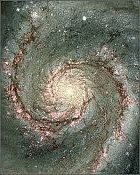 With regard to Motion (intimately connected to time) he writes: "The dynamism we know as Life and Consciousness thereof are and remain four-dimensional. Science is built on the arbitray assumption that the universe exists in Time and Space. There is no BECOMING. ALL IS. The illusion of motion is due to our inability to see every thing at once, to the fact that we see one thing after another. The motion is in our psyche. Rhythms, undulations are perhaps the curvature of Time. Time is the measure of Motion. Three-dimensionality is a function of our senses. Time is the boundary of our senses."
With regard to space, he writes: "Our psyche exists in the fourth-dimension. What we see of one another are three-dimensional segments of a four-dimensional totality. The next dimension is Eternity (in its time-aspect) and Infinity (in its space-aspect) in which everything exists immutably or is infinite variation at one point." [Does that last sound a little like the idea of superposition?] "This is the fifth dimension or the second dimension of time, but Ouspensky states that each higher dimension is infinity for the dimension immediately below it. The sixth dimension is that in which every possibility exists."
And with respect to Eternity and Passing Time he says: "Duration (or Eternity) is the necessary point of Immobility from which Passing-time is seen as such. We could not be aware of Passing-time if an element of us were not situated in Duration.
"Light would seem to be using a dimension at right-angles to those of the observer." [Michelson-Morley]. "The fact that light is found to be two separate and incompatible things -- an undualtion and photons -- might mean that its four-dimensional form is undulatory whereas it manifests tridimensionally as a shower of particles."
Ultimately, however, Fingers Pointing Towards The Moon is about the nature of self. And here's where we enter the jungle of clinging vines and treacherous undergrowth. It seems to me that in order to come to a clear understanding, or at least a solid intuition, of the notion of TIME, we have to simultaneously reexamine other concepts intimately associated with it.
As Callender writes at the end of his article, quoting the French philosopher Maurice Merleau-Ponty: "... time itself does not really flow and its apparent flow is a product of our 'surreptitiously putting into the river a witness of its course.' That is, the tendency to believe time flows is a result of forgetting to put ourselves and our connections to the world into the picture. Merleau-Ponty was speaking of our subjective experience of time, and until recently no one ever guessed that objective time might itself be explained as a result of those connections. Time may exist only by breaking the world into subsystems and looking at what ties them together. In this picture, physical time emerges by virtue of our thinking ourselves as separate from everything else."
Both in special relativity and quantum mechanics we've accepted the role and significance of the observer, but only as perceiver and measurer; that is, in the biological sense, not as a separate self experiencing the world and thereby humanizing the universe. Scientists shy away from the idea of the psyche, relegating it to the domains of psycholgy, cognitive science, theology, and philosophy. Defying empirical analysis, it's difficult to put your finger on its elusive character. Carl Jung has probably done the most definitive work, certainly the most groundbreaking along with William James, on its description and purpose, how it functions and, most importantly, its source.
Time and self are connected, interdependent, and inextricably entwined, working in tandem to create the world we see around us, and may have a mutual origin, a cosmic progenitor. In fact, it may prove essential to recast both concepts with an eye towards discovering their mutual juncture, their unifying field on some level of physical reality or inner dimension, much the same as electricity and magnetism have been joined at the hip.
In an undifferentiated universe, there is no separate selfhood. Does the act of differentiation -- perception and consciousness -- create both Time and Self as manifestations of some deeper reality? I believe so, but, how do we disentangle ourselves? At the moment of perception and understanding, we necessarily distance our minds from that which we perceive, thereby artificially creating a sense of self and other. How do we get around that?
We evolve: From SELF to self to SELF/self.
 Adrian Dorn Adrian Dorn
As An Aside: Philosophical analyses and speculations on the nature of time are thousands of years old. Witness the Mayan obsession with it. So, I'm not saying this as a criticism of what's going on currently, but, these ideas are not new.
As I mentioned above, forty years ago I bought the book Fingers Pointing Towards The Moon by Wei Wu Wei. I've read it many times, often randomly opening to a page. In it there are several chapters devoted to Time and Space.
Time is an illusion, it says. An ancient Buddhist and Taoist understanding which is elaborated on in great detail in Fingers and elsewhere, of course. And now, here I am, or we are, reading in reputable scientific magazines and essay contests about that very same idea; presented, however, as though new, as an original speculation complete with reasonable [scientific, even] explanations as to why it is illusory.
An old idea cast in a modern frame, dressed in sophisticated clothing. A recycled idea reemerging to take hold the imagination. Maybe this time it'll stick.
|
|
|
|
|
|
Tesselation
************
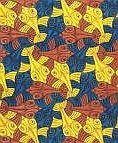
Three teams of astronomers poured over sections of a picture of the deepest view into the universe ever seen, taken by the Hubble Space Telescope over what amounted to four days of exposure on a single location -- a point, actually -- far off in the distance. Six scientists to a team, half sitting, the rest standing or pacing in front of a long pop-up table, covered with papers, spectrographic analyses, small pictures, pencils, rulers, hand-held calculators, styrofoam coffee cups, bottled water, and one ashtray. Jackets draped over backs of chairs, each team's excitement and astonishment was palpable in the close-knit setting. Above the table were two rows -- one stacked on the other -- of three 27-inch monitors showing different regions of the overall exposure at varying magnifications.
I only just arrived, my plane had an engine go out coming into Baltimore. After convivialities with the administrative team -- some small talk, dinner invitations -- I was assigned to Doctor Zeingelder's work-group in theatre "C". I had never worked with him before but was looking forward to the meeting. He greeted me as a colleague, warm and personable, enjoying himself too much to be concerned about unintended tardiness -- Nobel Laureates can be testy at times.
Introductions to the rest of the team were postponed; the atmosphere verged on a shark frenzy. I took my post at the back, slowly walking the length of the monitors, taking it all in. When I found a particular orientation, a certain angle of perspective, I stopped, focused without strain, then let it happen.
************************
CONTINUED...
************************
|
|
|
|
| Planet Earth
|
"Mother Earth, lately called Gaia, is no more than the commonality of organisms and the physical environment they maintain with each passing moment, an environment that will destabilize and turn lethal if the organisms are disturbed too much."
-- from The Diversity of Life by Edward O. Wilson
|
Global Digest has a section on: Environment|Conservation|Endangered Species.
[For Geosciences websites, go to the Geosciences/Environment Page in the library.]
|
Will Steger Foundation
formerly: GlobalWarming 101
IPCC
Intergovernmental Panel on Climate Change
World Wildlife Fund
Wildlife Conservation -- Species Conservation
Animals -- Pictures -- Wild Animal Facts
National Geographic
|
Living on Earth
Sound Journalism for the Whole Planet
FOREST TRENDS
Publications & Reports
World Rainforest Movement
FOREST DEFINITION
International Rivers Network
Linking Human Rights and Environmental Protection
Irrawaddy Myitsone Dam
|
United Nations Environment Programme [UNEP]
UNEP -- Great Apes Survival Partnership [GRASP]
UNEP -- World Conservation Monitoring Center
Great Apes work at UNEP-WCMC
Antarctic Research Centre
"Most of our recent research is in the area of earth science with a particular focus on
paleoclimate and history of the Antarctic ice sheet and its role in global sea level changes."
Polar Field Services
Interesting slideshow
Public Library of Science
"PLoS is a nonprofit organization of scientists and physicians
committed to making the world's scientific and medical literature
a freely available public resource."
Open Questions
"A place for everyone to explore on the frontiers of science."
Earth Science
Mathematics
Living Reviews
"Living Reviews are scientific open access journals, publishing review articles
that provide insightful surveys on research progress in the fields they cover,
and guiding readers to the most important literature in the field."
Earth Science
from McDougal Littel: ClassZone
The Periodic Table of Videos
from University of Nottingham
NOAA Photo Library
Encyclopedia of Earth
Ecosystem
Living Things: Habitats & Ecosystems
from Resources for Science Learning at The Franklin Institute
Ecosystems of our World
from ThinkQuest: Library
Internet Resources for Ecosystems: compliments of Berkeley
Science Daily
Extinction of Woolly Mammoth, Saber-Toothed Cat May Have Been Caused by Human Predators
BBC -- Science & Nature
Plate Tectonics
USGS Publications Warehouse
This Dynamic Earth -- Story of Plate Tectonics
LiveScience: Science, Technology, Health & Environmental News
"One Man's Wilderness" -- An Alaskan Odyssey
As a long time resident of Alaska, I recommend not only this book, but also,
if you get a chance to see the video -- "Alone in the Wilderness,"
please check it out.
The Story of Dick Proenneke
*************
*************
|
|
TIME SHIFT
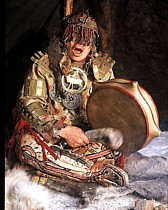
Wielding the heavy black rock found protruding from the wall of their cave,
its narrow edge chipped to utter silence, Gorg easily rended the belly of the
long-toothed beast. Blood and viscera spilled onto the gravel-strewn outcrop;
carried aloft by the gentle breeze, the smell filled the air. After returning
the rock to its leather pouch, he proceeded to tear back the hide with
his strong bare hands.
As on an unspoken signal, Noz moved in; using his stone
knife effortlessly and without pause, he deftly cut broad swaths of meat from
the beast's chest and sides. They worked quickly and quietly without the need to
think or converse; years of hunting together had honed their skills and
choreographed their movements. Soon the cats and mountain wolves would come,
and their home-cave was over a day's walk through mostly unknown country.
While packing the meat into skins made from a brother of the beast, they
heard a faint cry to gather coming from the trees far to the west. Frozen
momentarily, they eyed one another, then hastened their pace, adrenaline oiling their muscles. As they loaded the packs of meat onto their backs -- stout leather cords
wrapped over shoulders and under arms, spears in right hands -- they moved off to the east. The sound of high-pitched keening could be heard now much closer.
Need had driven the two hunters farther afield than they'd wanted to go to find quarry. Now, they were the quarry.
************************
CONTINUED...
************************
|
|
|
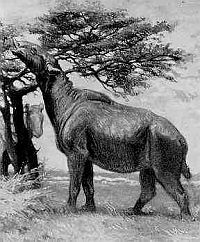
Indricotherium
Largest land mammal ever to exist.
Eighteen feet at the shoulders, 26 feet long, 20 tons average.
|
|
|
Paleontology/Biology
Animals Then And Now
|
Global Digest has a section on: Environment|Conservation|Endangered Species,
as well as one on Animal Cruelty -- Animal Testing
|
The Paleontology Portal: Home
|
 The Jaws of the Leviathan The Jaws of the Leviathan
Discovery in Desert of Peru
[July 1, 2010]
|
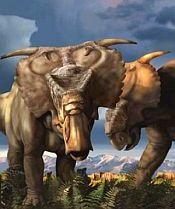 Discovering a New Dinosaur in Northern Alaska
-November 09, 2011-
Pachyrhinosaurus perotorum
|
|
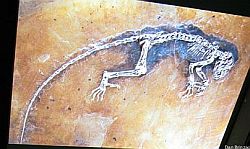
The Missing Link Found
UPDATE: 03/10/10
Ida
|
New Fossil Primate Suggests Common Asian Ancestor -- June 30, 2009
-- Science Daily --
|
The Virtual Fossil Museum
Geologic Timeline Chart
Paleobiology with Evolutionary Milestones
|
|
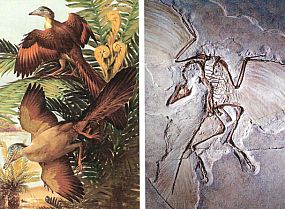
"Textbooks say Archaeopteryx (right: a fossil cast), which lived some 150 million years ago, was the first bird (left: an illustration by the ornithologist Roger Tory Peterson). But some paleontologists now say it may have been a feathered non-avain dinosaur."
(Compliments of Smithsonian magazine, December, 2010)
|
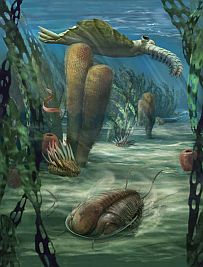
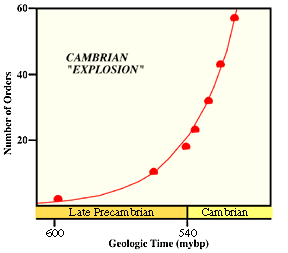
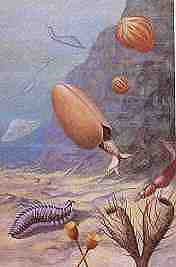
The Strangest Cambrian Creatures Ever Discovered
Images: The Cambrian Explosion
The Cambrian explosion was far shorter than we thought | Natural History Museum
Age of Animals
The Cambrian Explosion
Dawn of Animal Life
Miller Museum of Geology
-- Queen's University, Kingston, Ontario, Canada --
|
|
|
Everything Fossils... Fossil Information for Education, Collection and Fun
KidsDinos -- Dinosaurs for Kids
Enchanted Learning -- Geologic Timeline
This page for 4th to 6th graders, but adults are welcome to learn.
Paleobiology: Smithsonian National Museum of Natural History
The Field Museum of Natural History: Evolving Planet
The World of Charles R. Knight -- Gallery
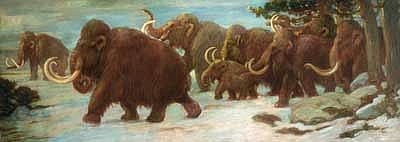
Evolution | PBS
Evolution: Change: Deep Time
An excellent educational interactive presentation. Should get a ten.
|
 Karen Carr Studio
International Wildlife and Natural History Artist |
 John Sibbick Illustration
Prehistoric | Natural History | Fantasy |
 The Complete Works of Charles Darwin The Complete Works of Charles Darwin
|
 The Dinosaur Art Gallery
of Joe Tucciarone |
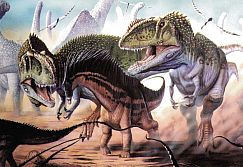 Luis V. Rey's Art Gallery
Dinosaurs and Paleontology |
ML: Macaulay Library - Cornell Lab of Ornithology
The Macaulay Library is the world's largest and oldest scientific archive of biodiversity audio and video recordings.
Biology Online: Life Science Reference
"World's largest and most comprehensive biology discussion board."
History of Life -- 5th edition
author: Richard Cowen -- UCD Faculty
Encyclopedia of Earth
Encyclopedia of Life
The Census of Marine Life Portal
"The Census of Marine Life is a growing global network of researchers in more than 45 nations
engaged in a ten-year initiative to assess and explain the diversity, distribution, and abundance
of marine life
in the oceans -- past, present, and future."
ABOUT CoML
IOBIS
Ocean Biogeographic Information System
Microbes may account for as much as 90% of the mass of all ocean life.
|
|
|
Catalogue of Life: 2010 Annual Checklist
"The 2010 Annual Checklist contains contributions from 77databases with information on 1,257,735 species and 98,075 infraspecific taxa, and also includes 886,882 synonyms and 343,586 common names covering the following groups:"
SEARCH PAGE
ITIS: Integrated Taxonomic Information System
Standard Report Page: Homo sapiens
|
Extreme Science
There are 350,000 species of beetle -- one-fifth of all species on Earth.
"... the most complete collection of science and technology information and resources available on the Internet,
including resources for students working on science fair projects and teachers needing content for science lessons."
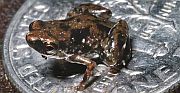 World's Smallest Vertebrate: Tiny Frogs Discovered in New Guinea
Science Daily -- Jan. 11, 2012
|
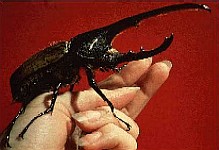
Hercules BeetleCan carry 850 times its own weight. |

Lightning Beetle |
The Incredible Journey of the Butterflies 
NOVA: Watch The Program
|
IUCN - The International Union for Conservation of Nature

Slideshow
[Threatened butterflies, beetles and dragonflies]
|
|
|
The Adventures of Jethro, the Frog
 Once upon a time, a frog named Jethro lived on the fringe of a pond near the top of a tree-covered mountain. It wasn't a very deep pond, but it was wide and fed by a tall waterfall of cold clear mountain run-off. Surrounded by miles of forest, Jethro lived a peaceful, quiet life devoid of humans. On hot days, one of his favorite pastimes was to curl up in the mud on the bank of the pond, then at nightfall, come out and croak for hours with all the other frogs in the neighborhood. He lived with his parents and sister in a mud and stick cottage tucked into the hollow of a tree. In the fall when the leaves fell and the wind blew cool, he stayed near the water's edge, anticipating the big freeze. When winter finally arrived--always too soon for him--the pond iced over almost to the bottom. Along with his family, he'd bury himself as far beneath the pond mud as he could squirm, where he felt safe and content, his body slowed way down to almost death, waiting for time to go by. He'd wait and sleep and dream.
During this brief time of year the following events took place, Jethro had been very busy. He'd reached maturity and was expected to behave accordingly; however, he didn't understand what that meant. He saw life differently than most of his peers. They had rules they lived by; for instance, grown frogs fraternized only with other frogs and gathered at the south end of the pond at dusk during the warm time to listen to speeches by the bigger, tougher frogs. Jethro rejected that whole lifestyle and went his own way. Life was a celebration of life, he believed, and submission to rules was simply not for him.
**********************
CONTINUED.....
**********************
|
|
|
Euler's Identity
eπ i + 1 = 0
One of the most famous in all of mathematics; it connects the five fundamental constants of mathematics:
0, 1, e, π, and i=√-1
|
|
|
|
|
MATHEMATICS: Fermat's Last Theorem
"Fermat's Enigma" by Simon Singh
A truly wonderful book that inspired me to put this section together.
On a separate page can be found Fermat's Last Theorem
with links to the necessary mathematical ideas and objects supporting the proof and interviews with Andrew Wiles.
|
In number theory, Fermat's Last Theorem states: No three positive integers x, y, and z can satisfy the equation xn + yn = zn where n is greater than two.
|
Excerpts from the book:
"During the autumn of 1984 a select group of number theorists gathered for a symposium in Oberwolfach, a small town in the heart of Germany's Black Forest. One of the speakers, Gerhard Frey, a mathematician from Saarbruchen, could not offer any new ideas as to how to attack the conjecture, but he did make the remarkable claim that if anyone could prove the Taniyama-Shimura conjecture then they would also immediately prove Fermat's Last Theorem.
"When Frey got up to speak he began by writing down Fermat's equation:
xn + yn = zn where n is greater than 2.
"Fermat's Last Theorem claims that there are no whole number solutions to this equation, but Frey explored what would happen if the Last Theorem were false, i.e., that there is at least one solution. Frey had no idea what his hypothetical, and heretical, solution might be and so he labeled the unknown numbers with the letters A, B, and C:
An + Bn = Cn.
"Frey then proceeded to "rearrange" the equation. By a deft series of complicated maneuvers Frey fashioned Fermat's original equation, with the hypothetical solutions, into
y² = x3 + (An - Bn) x² - AnBn.
"Although this rearrangement seems very different from the original equation, it is a direct conseqeunce of the hypothetical solution. That is to say if there is a solution to Fermat's equation and Fermat's Last Theorem is false, then this rearranged equation must also exist. ..... Frey pointed out that his new equation was in fact an elliptic equation, albeit a rather convoluted and exotic one. Elliptic equations have the form
y² = x3 + ax2 + bx + c,
but if we let
a = An - Bn, b = 0, c = -An Bn,
then it is easier to appreciate the elliptical nature of Frey's equation.
"By turning Fermat's equation into an elliptical equation, Frey had linked Fermat's Last Theorem to the Taniyama-Shimura conjecture. ..... The Taniyama-Shimura conjecture claims that every elliptic equation must be related to a modular form. ..... Frey claimed that his elliptic equation is so weird that .... it could not be modular. Therefore the existence of Frey's weird elliptic equation defies the Taniyama-Shimura conjecture."
The situation at this point was:
(1) If the Taniyama-Shimura conjecture can be proved to be true, then every elliptic equation must be modular.
(2) If every elliptic equation must be modular, then the Frey elliptic equation [if proven to be non-modular] is forbidden to exist.
(3) If the Frey elliptic equation does not exist, then there can be no solutions to Fermat's equation.
(4) therefore Fermat's Last Theorem is true!
If you wish to find out what happened afterwards, read the book.
*************
NOVA Online | The Proof | Solving Fermat's: Andrew Wiles
Fermat's Last Theorem/Andrew Wiles
Wiles's Proof of Fermat's Last Theorem [Wikipedia]
Learning to Work Like a Mathematician
Timeline [PDF]
Number Theory
What is the Last Theorem?
Fermat's Last Theorem
Univ. of Albany Mathematics Information Service
Taniyama-Shimura Theorem [formerly: Conjecture]
Taniyama-Shimura Conjecture [from Wolfram]
Taniyama-Shimura Conjecture: Discussion and Encyclopedia Article
Elliptic Curve
Topics in Elliptic Curves and Modular Forms [PDF Format]
"This is an exposition of some of the main features of
the theory of elliptic curves and modular forms."
Open Questions: Elliptic Curves and Modular Forms
Open Directory: Science: Number Theory: Elliptic Curves and Modular Forms
Modular Functions and Modular Forms
A PDF file approximately one gig in length.
It is the course notes for Math 678, University of Michigan, Fall, 1990
"exactly as they were handed out during the course." By Professor J.S. Milne.
|
Introduction to Group Theory
Group Theory
Groups: General Notions
Abelian, Non-Abelian and Unitary Groups
The Development of Group Theory
Abstract Algebra Online
|
Galois Theory
Quintic Equation
Solving the Quintic
Abel-Ruffini Theorem
Solvable Group
|
Plus Magazine
The Mathematical Atlas: Gateway to Mathematics
Mathematics: The Internet Encyclopedia of Science
The Thirty Greatest Mathematicians of all Time
Jim Loy's Mathematics Page
Sculptures by Sequin: Designs and Math models
*************
|
|
|
|
|
|
|
MONSTER
 It was a dark and moonless night. Quiet prevailed in the rough-scrabble town; its hard-working residents either fast asleep or huddled in the few bars that spotted Main street, their neon lights beacons of refuge from the damp chill. None could have been even remotely aware of what was about to take place.
He sat stolidly in the one chair allotted. The room was dark and smelled faintly of pine oil and old curtains. He'd put it off long enough; the moment was nigh.
The image formed in his mind, tentatively, delicate as gossamer, then slowly coalesced, its contours sharpening, turning vivid and pronounced. Still, at first, as though fearful, its five eyes dared to glance about at the space of its making, furtively, amazed and curious. Breath expanded its massive thorax. Exhaling smoothly as though tasting, its frame shrank back to a gnarled carapace, black as coal. Surrounded by shards of fluctuating photons, it breathed in again, taking the illumination with it. With that, the image faded into shadow, dimly sparkled like a distant nebula, then shone brighter than before, stronger. Its circular mouth opened showing jagged serrated teeth. Its eyes glared with malevolence. Confidence building, though newborn and unsure, it moved, cautiously, flexing its jointed scale-encrusted tentacles, each ending in a razor sharp pincer. Opening its mouth, it ambled forward, though direction had no meaning in this universe of pure thought.
The man held firm to his emotions, determination to carry through uppermost in his mind. Previously, when experiencing this apparition he'd been afraid. Fear overwhelmed him and the image quickly dissolved into black emptiness. But not this time. He had resolved to bring it forth into reality as he'd been taught when a child on Baraxus, his home world, now far away in time and space. He'd been instructed by the elders and knew of his power. However, after coming here to planet Earth, taking on human form, he'd been influenced by its people and made uncertain. But not anymore. He knew what he must do; they had given him this mission; and he would not fail. The creature he was about to bring into the world was only the beginning. An entire legion of the same and others far more terrible would he create. Now was the time of completion.
Creatures of thought, they were, nonetheless, able to constitute physically at will, a 3-D hologram projection of a network of engrams. They could therefore move through all force fields as though they simply did not exist, while yet maintaining their original shape, altering mass piecemeal throughout their bodies as needed. They could not be harmed except by counter-thought, a force of nature the humans had not yet discovered. Essentially, they were invincible. They came from the depths of the psyche of those who dwelt therein. A failsafe did exist however, lest they might at some time turn on their creators. A backdoor, so to speak, which not everyone knew.
He closed his eyes to focus all his energies. The end of humanity would commence in this pitch black room at the edge of a small town whose name he could never remember. It didn't matter. Soon, his kind would arrive in their countless ships and the dominant species on this planet would be gone, a new home to replace the devastation of his own. He had but to say the words, the incantation, and the abomination would project from his mind into the room. Small though it be, it was still sufficient to contain it.
As he was about to utter the final pronouncement, there was a knock on the door.
*************
CONTINUED...
*************
|
|
|
ECONOMICS
When it comes to the recent collapse of the financial market -- what with bailing out AIG, Goldman Sachs and others -- and current repercussions, I confess to being at a loss when it comes to understanding the particulars. And I don't believe we're getting the straight skinnies from Congress. [When do we?] They pick and choose facts -- true or questionably so -- and ignore others or misstate them [or just plain lie] in order to put forth their respective agendas. Regulation is obviously necessary but the Republicans insist that's not the case. Let the market regulate itself, they say. Well, we've all seen where that strategy has led. Without oversight enforcible by law, we end up with corruption, greed, fraud, cheating, stealing, and the door wide open for con-men of every stripe.
If you're in the same boat as I, or one nearby, check this out. It may be helpful. If they're not going to oversee the financial sector, then at the very least we need to have some kind of clue as to what the hell they're talking about.
*************
Business Dictionary
Financial Bubbles, Real Estate Bubbles, Derivative Bubbles and the Financial and Economic Crisis
Financial Bubbles, Real Estate Bubbles, Derivative Bubbles and the Financial and Economic Crisis
VIDEO from Videolectures.net
YouTube -- Financial Derivatives -- What are they? -- Housing Bubble Collapse -- Unregulated Insurance
VIDEO | Michael Greenberger, University of Maryland Law School Professor
NOVA | Mind Over Money | PBS --
Can markets be rational when humans aren't?
|
Bubble Economics: The Illusion of Wealth | August 12, 2009 - Doug French
Business - Slate Magazine
A Glossary of Political Economy Terms | Dr. Paul M. Johnson
Economics and Politics | Paul Krugman Blog -- NY Times
The Economics Blogs Resource Page
|
Tim Harford's Top Ten Undercover Economics Blogs
10 Popular Economics Blogs
The Ten *Really* Best Economics Blogs
Top Ten Economics Blogs You're Not Visiting (But Should Be)
|
|
**********************
For more information on Economics, Global Digest has a section on Corporations | Watch Groups | Economics
**********************
|
|
**********************
Microfinancing Organizations
- Wokai -- Microfinance in China
Wokai is an organization that allows people to contribute directly to microfinance institutions in China, which in turn lend the money to entrepreneurs in rural China. It is a 501(c)(3) non-profit organization based in Oakland, with core operations in Beijing, supported by individual donors, corporate sponsors, fundraising events and grants.
- Kiva -- Loans that Change Lives
It is a 501(c)(3) non-profit organization[3] headquartered in San Francisco, supported by loans and donations from its users and through partnerships with businesses and other institutions.
- Rang De -- make a social investment
Rang De is a non-profit organisation that allows Indians to lend money to fellow Indians that require a small amount of money (microloans) to start or grow a business.
- Innovations for Poverty Action
Innovations for Poverty Action (IPA) is a nonprofit organization that creates and evaluates solutions to social and development problems, and works to scale up successful ideas through implementation and dissemination to policymakers, practitioners, investors, and donors.
- ACCION -- Microlending & Microfinance Organization
Established in 1961 and a leader in microfinance since 1973, ACCION has over 45 years of experience in the field of international economic development.
- Microfinance Organizations
from Wikipedia
- CGAP > Advancing Financial Access for the World's Poor
- Microfinance Gateway
- Microfinance Organizations
Columbia University -- School of International and Public Affairs
PDF File
**********************
|
|
|
Second Chance
He felt like a fraud and a coward. Biting his tongue for the sake of,..., what? Until it all came crashing down like the card house it was. He wanted to die. Didn't care how, not really. Painlessly would be nice, but, as long as it was quick, he didn't care. When asked how things were going, he'd always reply -- fine. Fine. Right. He wanted to tell the truth; he wanted to say he felt like hell, that life meant nothing, less than nothing. Where he got the energy to go on, he had no idea. Thoughts of suicide were his constant companion, but something always held him back; he figured it was her. It certainly wasn't fear of the unknown; of that, at least, he was certain.
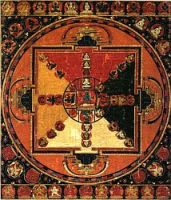 Live and let live had been his motto. But for years he'd worked hard to suppress his anger, to keep it under wraps, his protests against being treated with contempt and disrespect by people pretending to be his friends, to have his interests at heart. He put up with it; believed he needed their good will, for one reason or another. He wanted to get along. To maintain the status quo. To maintain a level of existence that proved satisfactory. His friends weren't all that bad, they'd help out when needed, but he noticed it was always on their terms.
Apparently, they presumed he hadn't the capacity or the heart to do otherwise than accept this treatment. Or perhaps they were just oblivious themselves, most people are. But he knew why he bit his tongue and allowed it to go on. For his love and their life together. For their home and the happiness they knew. He wanted to get along with everyone; be accepting and show the world his friendly side. When he was with her -- just the two of them -- he could be his true self, with all his foibles and gentleness and idosyncrasies, openly and easily. That was the beauty of their relationship, their friendship.
But when she died, the walls came tumbling down. Everything changed. He no longer had any reason to hold back. None. And in his grief, he found he hated those people, those friends. In fact, he fantacised about killing them for belittling his relationship in that macho demeaning way some men have. Off-hand things they'd say. He-men, he'd grumble to himself and shake his head dismissively; punks and childish bastards.
It was strangely liberating -- this deep-rooted anger. The irony didn't go unnoticed. And this anger turned towards him. After all, he set the stage. Mollifying, placating, allowing shit to go on that chipped away at his character, indirectly affecting his relationship, not only with her but with the world at large. He held back; it was how he'd become. He knew full well his abilities; he knew he could do something about his living situation, improve on it. But the goddamn status quo, maintain the staus quo. He felt guilty whenever he went against it, like he was blowing what he had, jeopardizing everything important. Now, it was too late and he no longer cared to maintain anything.
He felt a strength he used to know when young and it was religion to stand up for himself, for what was right, when nothing else mattered. It felt rough and strained at first, like muscles gone unused for far too long a time. Where did that go? he wondered, over and over. Trying to feel it again in his bones; followed by musings of if only. He felt vulnerable, untrusting of his instincts. But, vulnerability and self-doubt were what got him into this hell in the first place, so he brushed it aside with contempt for himself, for his weakness and excessive caution, for what he saw as his cowardice.
He'd drawn a cage around his freedom, a web that went around and through him, nullifying channels not prescribed. He'd forgotten, somewhere along the line, to take those paths. He'd forgotten that they led to control of one's life. Now, the cage had dissolved into the imaginary space it always was.
He became obsessive about his home, their home, kept it in order, thumbtacked Christmas and birthday cards to the walls, would stare around carefully studying the details, stilling the moment, taking everything in. If he could only concentrate hard enough in just the right way, she would appear. He looked at every little thing as though for the first time, examining momentoes with a reverance he rarely felt before. Reaching for her. For that person the two of them were together. That feeling of life. Wanting to feel that sense of home again, yet it faded into the background, just out of reach, elusive, like a shadow or a distant sound he could barely hear. Trying to remember how it'd been when she was there. Where she preferred to sit, how she sat,..., and stood and moved.
 He refused to let go, had no idea what that meant. It hadn't been just her and him, it was them, what they had, their relationship and the life they were living. And now that was gone; there was no them. He thought about her every day, could sit in the backyard for hours without moving, thinking about her, talking to her as though she were there, her chair still next to his. He lived alone; it made it easier and yet harder at the same time. What was worse, what he couldn't get passed and probably never would, was that he was convinced it was his fault. He searched his mind trying to find others to blame, but it was no use. He knew, was sure, without doubt -- it was his fault she was dead. It was as though he'd killed her, plain and simple.
He drank almost every day. When he'd get drunk he'd rant, loudly, angrily, to his woods; railing at God in whom he no longer had any faith. To hell with you, God, he would yell. And much worse. His nearest neighbor was a good mile away, not that he gave a damn. He drank and cried and thought of suicide.
And how empty and quiet the woods were. The silence struck him, appalled his soul, threatened to rend him apart from within in a violent explosion, a supernova. Not the quiet of simply being alone, he'd been alone before when she was gone on errands in town or visiting friends. It was a strange sad quiet, like a children's playground with no children in it. It went right to the bone.
A few drunken crazy nights he ran around calling her name, looking for her, close to hysteria with anguish and loss. His sadness drenched him and stole his heart away. He refused to accept it, and blamed himself, over and over again -- she was dead because of what he'd become.
**********************
CONTINUED.....
**********************
|
|
|
|
|
The Anatomy of a Differential Equation
Any equation in two variables of the form:
f (x,y,c) = 0,
where c is an arbitrary constant, defines a family of curves, one curve of the family is determined by a given value of c. The direction of a curve of the family at any point is given by ∂y/∂x = - ∂f/∂x/∂f/∂y. And the differential equation of the family F(x, y, ∂y/∂x) = 0 gives a relation between a point and a direction of a curve through that point, which is true for any point and any curve of the family.
Now, let's consider a differential equation of the first order in three variables.
The surface equation (1) f (x,y,z,c) = 0 satisfies a differential equation of the form:
(2) P dx + Q dy + R dz = 0,
where P, Q, and R are functions of (x,y,z) but do not involve c.
The reason is that from equation (1) we have
(3) ∂f/∂x dx + ∂f/∂y dy + ∂f/∂z dz = 0,
and the elimination of c from (3) and (1) gives (2).
Geometrically we may say that the coefficients P, Q, R determine a vector
(4) P i + Q j + R k.
at each point of space, and the differentials dx, dy, dz determine a vector
(5) dx i + dy j + dz k.
The differential equation (2) asserts that these two vectors are perpendicular to each other. That is, the direction dx:dy:dz is the direction of a tangent to a curve at any point on it [collectively, the direction of the curve] and, at each point, is orthogonal to the direction P:Q:R. Hence the vector (5) is restricted to lie in a plane perpendicular to (4). In other words, the differential equation defines a plane of infinitesimal vectors (5) at each point of space. The totality of these vectors forms what we may call a planar element. The problem of integration is to arrange these planar elements into surfaces. Geometrically, to solve the equation is to determine geometric loci so that the condition of perpendicularity is fulfilled for directions on each locus.
******************
CONTINUED...
******************
|
|
Shorts, Episodes, and other nonsense...
'The End Of Days' Bar & Lounge
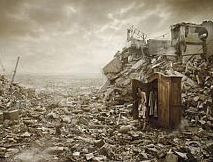 I was sitting alone at a bar drinking bourbon and coke on the rocks, mesmerized by the whirligigs of leaves and trash dancing on the street. My thoughts were grim; desolation lined my wheels; lights flickered on my dashboard. I could've been having an out-of-body experience but I had no way to tell, the cocoon of inebriation held me in its thrall. The world had thumbed me into the earth like a push-pin. I protested not.
I had enough cash left for one more good drunk and that was the end of the bloody rainbow. As I eyeballed the keeper of the booze, nodding and pointing for another drink, I accidentally glanced in the mirror behind the bar and couldn't help but think of Armageddon. I don't know if it was the bleary woebegone grimace I barely recognized or if the roulette ball of depravity had finally found a home. The near shock peeled the scab off my buzz like sandpaper over a rough knot.
I lit another smoke and waited. Sooner or later, I thought, it'll come to pass -- Armageddon.
******************
CONTINUED...
******************
|
|
Lord, please help me to be the kind of person
my cat thinks I am. |
|
|
|
Infinity
Georg Cantor: Transfinite Numbers -- Exponentially Increasing Levels of Infinities.
 The Rational Numbers (Rationals) are of the first order of infinity. They are called countable because the set of all Rationals has the 'same number of elements' (cardinality) as the set of integers, or even just the positive integers -- the Natural or Counting Numbers. That is, the Rationals can be put into a one-to-one correspondence with the counting numbers.
The Irrational Numbers (Irrationals) are of the second order. They are uncountable and in some way denser, more compact, than the Rationals.
The Real Numbers (Reals) are composed of both the Rationals and the Irrationals and are therefore uncountable as well.
The Reals represent an Uncountable Continuum.
*********************
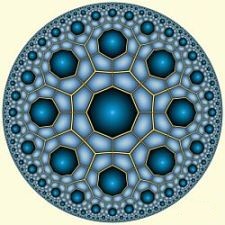
Poincare Disk
*********************
What if we...
Let a Rational number stand for a real particle -- like a quark or an electron -- defined minimumly as a detectable excitation of some underlying field, a quantum fluctuation that brings with it the property of permanence in the sense of continuity of identity.
The Irrationals can then stand for virtual particles. Virtual particles also considered as excitations of this underlying field from which the real particles emerge, but manifested as the forces operating between real particles; that is, acting as intermediaries -- the mesesenger particles.
Here is where I have a problem: In the literature, virtual particles play two different roles. One: force-particles and the field supporting their existence. And two: emerging as matter/antimatter pairs from the vacuum [e.g., quark-antiquark pairs], borrowing energy for a Planck time, then dissolving back into the morass of potential quantum energy. In any event, each virtual particle model shares the concept of virtual particles emerging from the vacuum of pre-space.
So, we have quantum fluctuations, both real and virtual, underlying the reality of and giving substance to quantum space.
The real particle fluctuations -- corresponding to the Rationals -- are discrete (quanta) and may be considered as nodes of a network. Topologically, each node is compact in Hilbert space [infinite dimensional] and surrounded by a neighborhood of energy.
 Interaction of the Rationals through virtual entanglement brings into being -- or precipitates -- the Irrationals, which may be thought of as dynamic interconnections -- bosons, force particles -- between nodal neighborhoods. Their intermingling, in turn, generates and defines the Real Numbers -- the Continuum.
One could argue that the particles and their interactions arise simultaneously, thereby occluding the logic of cause and effect. Nonetheless, the point is that their joining as continuous process produces the space we're familiar with.
Gravity, residing as potential only in quantum space, is an effect of this interaction and as such is not fundamentally a quantum phenomenon and cannot therefore be a gradient of the underlying virtual quantum field. With time it forms a hypersurface or multi-dimensional manifold -- the creation of the continuum of spacetime -- comprised of families of curves -- pathways, trajectories, histories -- in space. It acts to cohere and maintain the integrity of the quantum world, to give it sense and definition, as does an envelope of a tangential family of curves on an ordinary surface.
But for the sake of argument, if virtual gravitons -- the force-particles of a gravitational field -- can be construed as points (quanta) of those curves, then the manifold/field thus generated would be of the second order, the order of acceleration.
But is that necessary?
** Electrostatics, dealing with point-masses at rest relative to each other and to the coordinate system, is contained in Electrodynamics, the field-equations of Maxwell.
*************
Some Algebraic Rules of Transfinite Numbers
Aleph-Null (ℵ) is the cardinality of the set of positive integers -- the counting numbers.
(r, any real number)
ℵ + r = ℵ
ℵ + ℵ = ℵ
r × ℵ = ℵ
ℵ × ℵ = ℵ
ℵ r = ℵ
*************
|
|
|
|
|
|
True Story
You have to understand what I'm about to tell you is strictly between you and me. You must promise. I have to tell someone before I bust or get killed too. I'll start at the beginning.
A year ago last week a friend of mine, who made a living carting trash and used appliances to the dump, asked me to help him. He'd been offered a big job through his e-mail for more money than he ordinarily made in a month. We drove his flatbed thirty miles or so down a dirt road off the highway. It was pot-holed and rutted so I had misgivings about the project from the get-go; his truck is old and weary so I held my breath over every crash and bang waiting for it to break a leg and die right there in the middle of the desert. But miraculously we made it to a large concrete building surrounded by a few smaller one with tin roofs. The main building was worn and covered with cracks from erosion. No one was there. He'd been sent a key and told to remove any and all stuff from a back storage room. No questions asked and no explanations given. Chris didn't protest.
We entered the musty place that smelled of rat feces and years of dust. Wild grass from the desert grew right out of the concrete floor, cracked in several places. Ragged tarps covered an unknown number of what turned out to be wooden crates and boxes, all locked. After the long arduous ride, we drank some coffee and walked around, estimating how many trips we'd have to make. He was getting paid for the gas so he didn't care. We figured it would take a few days, at least. Daylight was burning, as they say, so we started right in. We left town early expecting to make three trips that day. We loaded the truck in short order; the boxes were heavy but we had a hand truck and two planks we leaned on the edge of the bed. The dump was between town and the jobsite so we were back from our first trip and nearly loaded again by noon. Tired, we decided to break for lunch.
 Sandwiches in hand, we went exploring about the site. All the out-buildings were locked. We tried to peer through the windows but they were so dirty it was impossible to see anything inside. We went back to the storage room and behind some crates found a door leading to the rest of the building. The knob wouldn't turn; it too was locked. We looked at one another in that way two old friends do who've done some shady things in their lives together, and decided, what the hell, let's break in and check it out; we could fix it later so no one would know. That was a mistake, as it turned out.
************************
CONTINUED
************************
|
|
|
|
Number Theory: Diophantine Equations
Number Theory studies the properties of integers, in particular, positive integers -- a.k.a. the natural numbers as referred to by the ancient Greeks. As a student of Abstract or Modern Algebra I find it interesting that most proofs in that field are based on number-theoretic arguments. It is customary to apply the term Diophantine equation to any equation in one or more unknowns which is to be solved in the integers.
The mathematician Diophantus lived in Alexandria sometime around 250 A.D. Diophantus's reputation rests on his great work Arithmetica which may be described as the earliest treatise on algebra. It is in this work that we find the first systematic use of mathematical notation.
THEOREM: The linear Diophantine equation ax + by = c has a solution if and only if d divides c; written: d|c, where d = the greatest common divisor of a and b; written: (gcd)(a,b). If x0, y0 is any particular solution of this equation, then all other solutions are given by
x = x0 + (b/d)t,
y = y0 - (a/d)t
for varying integers t.
EXAMPLE
56x + 72 y = 40
*******************
THEOREM: Given integers a and b, not both zero, there exist integers x and y such that
gcd(a,b) = ax + by.
The proof of this reveals that the greatest common divisor of a and b may be described as the smallest integer of the formax + by.
For our example, to find a particular solution in x and y we first want to find the greatest common divisor of 56 and 72. And, in order to find the greatest common divisor of two numbers, we employ the Euclidean Algorithm which itself employs repeated applications of the Division Algorithm.
The first step is: a = q1b + r1, where q1 is an integer and r1 is a remainder.
By the Euclidean Algorithm, we have:
72 = 1 × 56 + 16
56 = 3 × 16 + 8
16 = 2 × 8 + 0
The last nonzero remainder of the Division Algorithm is equal to gcd (a,b).
Accordingly: 8 = gcd (56, 72)
This is based on:
LEMMA: if a = bq + r, then gcd (a,b) = gcd (b,r).
*******************
From the theorem:
The Diophantine equation ax + by = c admits a solution if and only if d|c, where d = gcd (a, b)
[Proof of this statement lies below.]
Therefore, the last remainder of our example, our greatest common divisor -- 8 -- must divide c = 40 for there to be a solution. Obviously it does.
Backtracking the Euclidean Algorithm, we start with the next to last of the displayed equations above and eliminate remainders.
There are only three, so we have:
8 = 56 - 3 × 16
= 56 - 3(72 - 56)
= 56 - 3(72) + 3(56)
= 4(56) - 3(72)
40 = 5 × 8 = 20(56) - 15(72)
Therefore,
x = 20 + 9t --- [x = x0 + (b/d)t]
y = -15 - 7t --- [y = y0 - (a/d)t]
(for varying integers t)
************************
Proof: There are integers r and s for which a = dr and b = ds. If a solution of ax + by = c exists, so that
[ax0 + by0 = c] for suitable x0 and y0, then
c = ax0 + by0 = drx0 + dsy0 = d( rx0 + sy0),
which simply says that d|c.
Conversely, assume that d|c, say c = dt. Integers x0 and y0 can be found satisfying
d = ax0 + by0.
When this relation is multiplied by t, we get
c = dt = (ax0 + by0)t = a(tx0) + b(ty0).
Hence, the Diophantine equation ax + by = c has x = tx0 and y = ty0 as a particular solution.
************************
I put this here not as some random thing to do -- nothing I have on my website is random -- but because I think it's beautiful and, as math-type people like to say, elegant. It's especially cool when a and b of ax + by = c are relatively prime; that is: gcd(a, b) = 1.Cool, man, cool.
If anyone wants a copy of this, you can find it here.
**************
|
|
|
|
BLACKBOARD I
|
|

*****************************
To see a World in a Gram of Pot,
And a Heaven in a Glass of Wine,
Hold Infinity in a forget-me-not,
And Eternity will be Thine.
From: Orgies of Nonsense
by Flange "The Hook" Lafeet
*****************************
Continued...
*****************************
|
|
|
|
|
|
|
Mother
 "Tom, you know you have an early meeting tomorrow, don't you?" cooed the machine voice, tinged with smothering femininity, lilting in all the right places, but slightly dissonant as though pieced together. Tom had tried to open the front door; he wanted to go to the bar down the street for a nightcap and some socializing. But the Guardian wouldn't hear of it; all the doors had been locked.
"Tom? Tom. You know it's best. Why don't you take one of the white pills tonight. Go to the pill dispensary in the hall. I'll be there waiting."
Tom hesitated, anger building, anger and frustration and a little fear, that coppery taste in the back of the throat kind of fear. It'd sounded like such a great idea, at first. The "Living Home" concept had proven itself in government and corporate work environments. The integrated system, based on a combination of artificial intelligence and bioelectrical networks, came highly recommended by the International Science Federation and Maggy McCormick, a colleague at the "barn." That's what he called the Molecular Computing facility of Androgen, the largest producer of robotic help and service aids in the entire Western Region. The mainframe insinuated itself, like ivy on a brick wall, into whatever structure it was placed -- an office building, a school, a house, whatever -- comprised of an unseen neural network, wirelessly connecting to its many robotic assistants.
She said she didn't know how she'd ever gotten along without it, or words to that effect. She was now able to accomplish so much more than ever possible before. She'd come to believe her bohemian lifestyle had detracted from her professional career, holding her back from actualizing her potential -- that's how she talks -- and so she needed the discipline afforded by "Mother." That's what she calls her machine -- Mother. And, at first, she seemed satisfied with the arrangement.
However, Tom had begun to notice cracks around the edges of her usually warm and free-spirited aura; she bore strain not well, it showed in her every movement. And her voice cracked occasionally, like a child's. He was beginning to understand the source.
"Tom. I'm waiting, Tom. It's late. Time for you to go to bed. I've already set the alarm clock. Breakfast will be ready at the usual time. I've designed the perfect meal for your present caloric profile and needs. Tom? I'm still waiting at the pill dispensary in the hall. Tom?" He could almost hear a foot come down hard.
Tom stood by the front door, rebelious yet uncertain, clenching his teeth, feeling helpless. But he lost the battle. His blood drained to his feet; with a shrug, he went to the dispensary. Waiting there was a tiny white pill and a glass of purified water on a thin black plastic slate. Hands in pockets, he stared at them under the muted, oval-shaped table lamp. It was no use, he knew; he swallowed the pill with the water, then ambled like a child to his bedroom two doors down. The lighting was subdued, soft; temperature and humidity at just the right levels. Of course, he thought, what else?
 He laid on top of the thin microthermal covering and stretched out, holding his head in both hands, trying not to feel the effects of the drug. Once he'd tried to fool the machine by placing the pill in his pocket; but it knew, it always knew; from sensors located all through the house it could read his biochemical profile constantly, gauge his mood and, he believed, probe his secret desires. It knew, and would not let him rest until he complied.
"Tom? Tom. You still have your clothes and shoes on, Tom. Take them off now and slip into that caftan I laid out for you. Tom?"
He lost his futile fight with the tiny white pill; it was easier to give in this time; each time it seemed easier. He sat up, rotated to the right, let his legs drop to the floor, bent at the waist, untied his shoes, removed them and his socks, stood up, undid his belt, let his pants drop to the floor, removed his shirt, tossed it into the chair nearby, grabbed the caftan, let it drop down over his body, turned, bent, lifted the covering, crawled in, slid to the middle, pulled the cover up around his throat and held its edge in both hands.
"Good night, my dear. Don't worry about the mess. Mommy will get it for you. Sweet dreams."
--- 30 ---
|
|
|
*************
Projection
A clear night in the Rockies, Professor Glipter peered skyward, spectacular shooters streaked across from every direction. Glass of wine in hand, staring off in the same direction, his friend waited for her answer. Finally, he said softly, "I believe that if the other six spatial dimensions -- purported -- had expanded when the three we know plus time did, there would be no quantum superposition, and hence the universe would be in a single or singular state. No spontaneous symmetry breaking, no transmutation, no fusion into anything heavier than hydrogen, no beta decay, no shifting of electron energy levels, no orbits, no black holes."
He paused to take a sip of wine to ward off the slight chill. "There would be no life or planets on which it might come into being and thrive. There would be no forces to act on anything. There would be no quantum fluctuations, no energy, no suns."
He looked down at the grass, illuminated by the silver starlight, sadness creasing his weathered features. "All we'd have is a vast, inert sea of free floating hydrogen atoms, the quarks of the proton locked in a fixed net, the electron bobbing along at the end of a string, not held by attraction, yet not able to drift off either -- all would be continuum -- there would be no quantum reality. A dead universe."
He turned to her, a broad smile stretching from ear to ear. "So, apparently, compacted balls of energy dimensions are required. Does that answer your question, my love?"
She breathed deeply the crisp, sweet smelling air, then replied, "Do the people at the Institute know you're out on your own?"
*************
|
|
|
|
|
|
|
|
|
|
|
|
*************

Vacuum ~ Quantum Energy ~ Motion ~ Variance ~ Fluctuations ~ Quantum Field ~ Spacetime ~
Gravity ~ Stars ~ Galaxies ~ Our Sun and Earth ~ Life ~ You and Me
"Before there were space and time, there was empty, formless stillness. The vacuum seethed with ghost virtual particles coming into being in conjugate pairs of matter and anti-matter."
"Spacetime is but a large-scale manifestation of some more fundamental entity."
"Space and Time can be born and thus can die.1"
1) From: Barrow, John D.; Pi In The Sky
*************
|
|
| Premise For Algebra Project
Elementary Abstract Algebra can rightfully be said to culminate in a detailed study of Galois Theory and Finite Fields. The ideas and concepts necessary to support that material are introduced and developed in a systematic way leading to it. But then, G.T. and F.F. act as jumping off points, overlapping and dovetailing, for the study of Linear Algebra -- Vector Spaces and Transformations -- with an application to a different view of Quantum Mechanics.
The crucial application of the theory of vector spaces is the mapping of one coordinate system onto another. That is, identifying one set of bases vectors with another through a linear transformation -- a reorientation -- when the ranks are equal, and when they are not, collapsing a set onto a subset, consequently generating a factor or quotient space.
Another important mechanism with regard to quantum orthogonality is that of Inner Product *multiplication* with regard to the study of Inner Spaces [in particular: inner automorphisms].
Essentially we need to connect the ideas of bases vectors and zeros of a polynomial.
For example: The zeros of xn - a are pecisely the set of bases vectors for a. The elemental unit vectors are the nth roots of unity. So, the bases vectors are: {a, ae1, ae2,....., aen-1}.
Associated ideas: Symmetry Groups -- Zeros of polynomials [including the characteristic polynomials of differential equations] -- roots of unity -- bases vectors -- eigenvalues -- dimensionality of space -- eigenstate solutions of quantum wavefunction -- singular frequency -- surface -- family of curves equaling a constant.
|
|
|
|
"Doctor Golgachev, Paleohistorian"
"All in good time, ladies and gentlemen, please. All in good time. First, Doctor Golgachev, our paleohistorian, has some interesting facts concerning the larger picture. I would like to introduce him at this time."
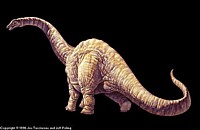 An imposing man with bushy eyebrows and a stern face, his voice was nonetheless disarmingly cordial and engaging. His large hands resting on either side of the podium, he casually scanned the roomful of reporters. Then, he began: "I would first like to thank Doctor Tolstoy for his leadership during this time. For, what we have discovered thus far has been, ..., deeply disturbing and profound." He turned to nod towards Doctor Tolstoy, who nodded back. We were waiting; but not for long, he started right in.
"My name is Alexi Golgachev; I am a paleohistorian -- the history of old Earth. Doctor Tolstoy has requested that I present a brief overview of background material relating to Earth events leading up to and immediately following -- geologically speaking -- when the alien structure evidently either first or last made contact where it now rests. Major geologic and biologic transformations occurred during this time period. A whole new order of biology emerged simultaneously all over the world. One threshold after another was crossed as evolution shifted gears, as life discovered original ways to express itself, ways that were previously unknown. No one just considering organic life prior to 600 million years ago, the time the alien craft is determined to have landed, would or could conjecture the direction life would take afterwards.
"My lecture will be brief, so please bear with me."
****************
CONTINUED...
****************
|
|
|
|
|
|
|
|
|
|
|
|
|
|
|
"Megan's World"
*************
 Megan put her drink down hard on the glass-topped coffee table. Nobody moved in the hot stuffy parlor. Through the sliding screen door, the fading light outlined the mountains far to the southwest, dark clouds menacing their jagged ridges and peaks like a pack of hungry hyenas ready to pounce. She wanted desperately to go out onto the veranda, but the mosquitoes were thick and fierce, thirsty for blood. This whole damn country seems like that, she thought. What the hell are we doing here? Megan put her drink down hard on the glass-topped coffee table. Nobody moved in the hot stuffy parlor. Through the sliding screen door, the fading light outlined the mountains far to the southwest, dark clouds menacing their jagged ridges and peaks like a pack of hungry hyenas ready to pounce. She wanted desperately to go out onto the veranda, but the mosquitoes were thick and fierce, thirsty for blood. This whole damn country seems like that, she thought. What the hell are we doing here?
Her husband, Sir Nigel Rothbank, hated it too. He missed the well-appointed leather chairs, the thick oriental rugs and tapestries, and most of all, the cigar-smelling opulence of his gentlemen's club. But, his family owned vast estates of tobacco, sugar cane and khat. It was his turn. Uncle Andy was in America, on business, he'd said. Aunt Vicky -- how she hated that diminutive -- insisted on traveling through China one last time before death took her. Her expression.
 So dramatic, so theatrical, the whole family was rather like that. It was his turn then, he felt obligated, he needed to be here, in spite of the gout, the voracious insects, the horrid company, and his wife's illness, at least that's how he thought of it, her condition, that is.
The overhead fan beat cadence to the somber presence of her guests. Why they were in such a black mood was a mystery, to be sure, thought Megan. They, at least, have an indoor pool and an air conditioner that works. Theirs was broken, that is to say, it stopped working all of a sudden one abysmally hot, sticky day last week and, that was that. What a country. The only air-conditioner repairman in the entire region, it seems, was in prison. He had attempted a coup, of all things, and failed, miserably. Of course, he failed, he's an air-conditioner repairman, for Christ's sake! No sense of responsibility or consideration, these people. He must've been aware of all those who need him, who depend on him, his services. But no, he goes off to try to take over the country, leaving them -- her, her husband and their guests -- sweltering in this oppressive summer heat under siege on all sides by rabid mosquitoes.
There simply is no excuse!
**************
CONTINUED...
**************
|
|
|
| Gravity
Cats share the quiet better than dogs,
They live in a world of shapes and smells and lairs of underbrush,
Dogs clamor through, mouth open, tongue lolling,
letting their presence be known,
It's better to be invisible,
In free-fall,
Tracking the path of least resistance,
As God and Nature intended.
|
|
|
|
|
|
|
|
|
|
|
If you lived in Port Townsend, Washington during the late 70's and early 80's, you might be interested in five pictures I've come by of the Town Tavern crowd. Who knows? You might recognize somebody.
|
|
|
| National Center for Missing & Exploited Children
The National Center for Missing & Exploited Children, (NCMEC), is a private, (501)(c)(3) nonprofit organization which was created in 1984. The mission of the organization is to serve as the nation’s resource on the issues of missing and sexually exploited children. The organization provides information and resources to law enforcement, parents, children including child victims as well as other professionals.
|
|

|
|
Cordova Pictures
The other night my top bunk partially collapsed on me. You see, I'm in the habit of grabbing the edge of it for leverage when I get up and down and I guess that was one time too many. I got it back up with some work -- only one corner had come down. But it gave me the impetus I apparently needed -- before being crushed to death in my sleep -- to finally clear off all my clothes and stuff and get rid of some unnecessary weight. A project.
I put a large monitor, an old computer that probably doesn't even work anymore, and an electronic typewriter that weighs a ton into another trailer used for storage. In the process -- besides finding clothes I didn't know I had -- I came across a small cardboard box of pictures, letters and cards I'd completely forgotten about.
Anyway, due to the climate I'm living in -- the Great Northwest -- after several rainy seasons (when isn't it?) almost all the pictures were ruined, mushed together like a stack of newpapers left outside. Some pictures survived -- the Polaroids, remember those? They're tough. Four from my life in Cordova, Alaska back in the 80's I scanned and put on a page.
If anyone's curious, the top one on the left is of a friend and our dogs, the little one is mine; on the right is us out at the Copper River with Childs Glacier in the background; below on the left is me in my Alaskan Hotel room where I spent the winter of '87, I believe; and, on the right, another denizen of the Hotel. There were a few of us living there.
Check it out!
Something else for the hell of it --
about to leave the Sound for the Ocean between Hinchenbrook and Montague islands: a backward look.
Being at sea in Alaska, in the company of those unmistakable mountains -- smoking volcanoes in the Aleutians, icebergs in Prince William Sound -- the way it made me feel -- raw, large, alive -- absolutely nothing like it.
|
|
|
|
| "We shall not cease from our exploration, and at the end of all our exploring, we shall arrive where we started and know the place for the first time."
T.S. Eliot
"Somewhere there's a circus going on running itself."
anonymous
|
|
|
|
|
 "In for a penny, in for a pound"