The Washington Post
by Viktor Dobrozny
May 12, --
Under The Table
In his den, Doctor Demian Dinklestein, analytical chemist, stared at the slowly rotating ceiling fan from the comfort of his favorite leather lounge chair. Surrounded by shelves laden with research materials and drafts of papers he'd written over the years, he pondered the problem he'd been working on for the past decade, considered by him to be a secret of the universe. It occupied his mind at off-hours when the real work for which he was hired by the university lost interest, varied as it was.
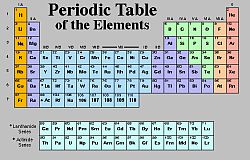 The Periodic Table was a mess, he complained to any who would listen. He understood Mendeleyev's rationale underlying the groupings and also appreciated its predictive power; nonetheless, he saw something about the nature of the elements which he believed would not only produce a more cogent, multitiered arrangement but would allow for adjustments to relationships hitherto unrealized. However, none of his colleagues gave it much credence; although, out of respect for his age, reputation and tenure, they pretended to see his point, obscure though it be.
His idea, to him, was simple and his inability to get it across was the source of the utmost frustration. He accused his peers and associates of being mired in the past, trapped by convention, fearfully protective of their precious reputations. It's not mysticism, he'd mutter: To each element associate a sound [note] and its spectroscopic color. To a group, link a chord and to a period, a melody. As each note is played the colors will blend and form compounds on a computer screen. Never before seen or imagined compound complexes could be discovered or created due to the degree of control over the mixing of color-sounds. Imagine a symphony of designer molecules? A Mozart of new materials with never before seen properties?
Instead of only the outer shell of an atom -- its valence -- being affected, deeper shells, ones closer to the nucleus, would enter into the combinations. It was all very simple, he'd say, but he couldn't conjole any algorithmically inclined chemist to work on the project. They were preoccupied with their own research, they would say; shrug, smile sympathetically, and walk away, quickly.
However, serendipity rules -- sometimes. One day in the school cafeteria, Doctor Dinklestein ran into a visitor from another planet. And he hasn't been heard from since. He left a note on the door of his offfice: Gone to Xulcatur -- back soon.
***********************
PaleoneurobotanyThe study of paleoneurobotany has few adherents around the world; it's a difficult subject, not meant for the faint of heart. Moreover, they are shunned by the rest of the scientific community as not only expousing what's considered fringe science, but also for not producing provable results, instead engaging in packaging pure speculation and conjecture as rock solid facts. Nonetheless, in the latest edition of the American Journal of Paleoneurobotany, no fewer than six foremost members of that esteemed yet obscure brotherhood collaborated on a single article of ground-breaking significance. To whit: 400 million years ago, plants were on the verge of organizing neural pathways from root through stem to leaf tip into the semblance of what can only be considered a fully functioning brain capable of cognition and basic reasoning.
 As it happened: Seventy-five million years after plants first gained terra firma, the self-organization of a primitive brain reached critical mass and the final threshold was about to be crossed. In fact, amongst varying species that collectively formed an ecosystem, a rudimentary language had evolved. The absence of evidence of any structure capable of functioning as vocal chords in the fossil record points to a form of telepathy as the medium of thought transfer. However, evolution hinges on contingency and necessity working in tandem. With the advent of sexuality -- flowering plants -- basic, nascent communication broke down. Consequently, as we see clearly today, they restricted themselves to spreading information through simple chemical means.
It's the general consensus of paleoneurobotanists worldwide that, owing to the exploitation by flying insects (symbiotic though it be), sex curtailed and derailed the incipient emergence of genuine intelligence. It's a curious aside that such preoccupation has the same effect on humans as well.
Plants are essentially opportunists, after all, especially the seed bearers who appeared after the green frontiersmen had secured terrestrial earth. The insects made it easy for these sexually active plants to reproduce and dominate the planet. Overwhelmed by clouds of pheromones in the otherwise unspoiled atmosphere, the original green spore plants -- ferns, mosses, cattails -- lost the will to evolve further along intellectual lines. They were thwarted, in other words, and regressed; instead concentrating their energies towards refinement of purely metabolic and phylogenetic design.
Were it not for sex, paleoneurobotanists contend, plants may have eventually left behind their vegetative existence to achieve an organic sentience beyond mere awareness and gone on to form societies and civilizations and, possibly, become mobile in the process. Imagine an intelligent life-form able to live off the sun? What great philosophers, teachers and statesmen they would have made. God knows they could do no worse.
However, they shouldn't think of themselves as failures for not realizing their ambitious dream. Maintaining the same basic body plan for 475 million years successfully is nothing to sneer at.
*****************************
Science Report: Thought Has A Material Base Doctor Oscar Gablinski, of the Munich Polytechnic Institute, and his team have recently discovered that thought affects the familiar material plane in a manner, and from an oblique dimension, previously unanticipated or imagined. That is to say, the brain's biochemical activity in the form of cogent coherent engrams is not only capable of generating four-dimensional phenomena in ordinary five-percent matter, but also is directly connected on multiple channels at once to the fabric of spacetime. As the stationary ether was once believed to exist, it had always been accepted that an intervening medium was necessary for thought-manifestation, but now Doctor Gablinski has shown that thought is everywhere; in fact, it is the medium. In other words, without thought, there would be no spacetime.
 As well, they've demonstrated that thought-energy can pass through both ordinary and dark matter with the same ease as neutrinos. Unlike neutrinos, however, thought encapsulates information about the nature of the universe, and, as such, is self-organizing, complex, and capable of replicating and evolving, much like an organism. Experiments have been conducted at the Polytech's Cognitive Research facility that clearly point towards the development of a theory describing how thought can be transformed into reality on all levels of existence. Apparently, it happens all the time, we're just not aware of it. That is to say, underlying the whole of the multidimensional universe is what may be called a psychic field, the source of all that is and the well-spring of cognition.
It's expected by the scientific community at large, and the neuroscience community in particular, that Doctor Gablinski will no doubt receive the Nobel prize for this work. His findings explain much, after all. They go to the heart of mysteries of the physical realm as well as shedding light on the nature of consciousness and its role in creating and shaping the world around us.
Ether: Physics: An all-pervading, infinitely elastic, massless medium formerly postulated as the medium of propagation of electromagnetic waves.
"If we could change our psychic apparatus and should then discover that the world around us was changing, this would constitute for us the proof of the dependence of the properties of space upon the properties of consciousness."
From Tertium Organum by P. D. Ouspensky
"The thoughts that one creates generate patterns at the mind level of nature."
*****************************
Science Report - November, 2126Doctor Leonardo McEisenstein and his team at the Appaloosa Academy of Sciences in Hungdung, China--Advanced Exploratory Division--have recently discovered that when the entire set of universes composing the local block are stacked on top of one another, for any parallel event and property under observation, the varying quantum series of probabilities 'fill in,' creating a continuum of infinite detail--fractally receding beyond the reach of present instrumentation--as well as an emergent configuration not otherwise apparent. This latter phenomenon has yet to be investigated; it may hold the key to understanding how blocks of universe-sheaves join and work together.
Parallel Universe Theory has been around since the late 21st century, but once Doctor McEisenstein's group had ascertained the generating function defining discrete distances separating adjacent universes, the frequency operator revealed, through the universe-frequency wave equation--the McEisenstein Equation of Isomorphic Membrane Mechanics--the precise characteristics of each quantumly varying membrane-universe by projecting it physically 'into' our space, its manifestation nonlinearly apprehended, its specific laws and constants translated conformally.
"There is yet much to learn," Doctor McEisenstein said at the awards ceremony, "we have only seen the frontier; now we have to discover what lies therein, what it all means, and,..., ponder the incredible vastness of the Hyperverse. We live on but a single membrane of a local block among countless billions, and for each block, the universes exist independently alongside each other and pass through one another unnoticed, while yet embedded one within the other. How can that be?"
At that point, his eyes welled up and a glassy look came over him; he was led away by two of his team.
*****************************
Click image to the right for larger version ... →
 Science Report
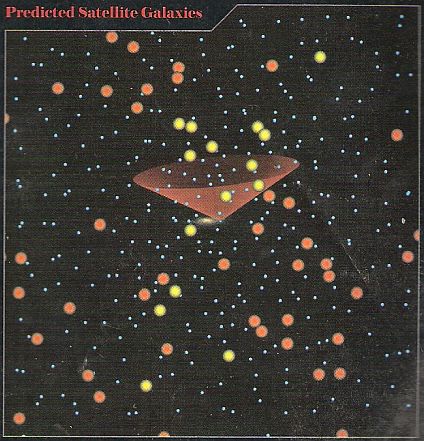
The picture on the right is a schematic of the Milky Way galaxy and its vast family of neighboring galaxies. I scanned the picture from the Scientific American magazine edition, October, 2011, page 45. The accompanying article is entitled: The Dark Side Of The Milky Way. It has to do with dark matter galaxies (satellites) and their affect on our galaxy, causing a serious warp in its outer region, like a vinyl record that'd been left on a heater. A quote from the article states: "In the universe as a whole, the ratio of dark to ordinary matter is almost exactly 5."
In the picture, the yellow dots respresent known satellites, the red indicate predicted faint satellites, and the blue, predicted dark satellites. The cone is the area surveyed by the Sloan telescope, our galaxy is just off to the left of its apex.
For animated versions of the diagram in this article, including a 3-D tour of the Milky Way, visit: scientificamerican.com/oct2011/blitz.
In the same edition there's an article on the Higgs boson. Here's a quote by Fermilab theoretical physicist, Bob Tschirhart, I thought was interesting: "There's a layer of existence out there we haven't discovered." Really. Physicists speculate on what is referred to as an "energy desert" existing between the realm they are able to probe now and the realm of new physics on the other side. As well, they speak of other levels of reality. If we include the current theorizing on the underlying nature of space and time, science seems to be on the verge of discovering worlds that have only been imagined in the contexts of science fiction and magic.
Within the fields of cosmology, astronomy, and particle physics, in particular, a major upheaval in the universe of thought concerning the nature of everything is in the offing. For example, the ingredients we have assumed necessary for life to exist may not be all that necessary. Nature coughs up its secrets through application of our cognitive faculties, based on the questions asked. So, our knowledge is constrained and fashioned by our humanity which limits us in our perception and understanding, how we filter and interpret reality. By so doing, we humanize reality. We can't help but be geocentric, projecting and imposing our understanding of how things work onto the universe. The Copernican revolution has not yet come to an end. If we can imagine that how we see things may not be the only way, that the human universe is not the only one, then, possibly, a new mode of questions might emerge the answers to which might elucidate the blind spot.