| BLACKBOARD IV | ||||||||||||||||||||||
|
***************************** January 31, 2012I have a cat friend who visits; he's about six or seven years old. He comes in to sniff around, inspecting every nook and crannie suspiciously--you never know--and then, after some coaxing, playing hard to get, curls up on my lap. I keep a bowl of food on the floor so he knows where he can get a snack. A couple of weeks ago we had a bona fide snow storm, it lasted for three days. He hung out the whole time, sleeping next to the electric radiator. Every so often he'd get something to eat, and once or twice a day, go out to do his business, but otherwise, he was glued to that radiator. No dummy he. The question I have is, does the Guiness Book of World Records keep tabs on things like how long a cat can sleep in a day? Because, if they do, I'd like to enter Sambo in the running. He sleeps for a couple hours, then sits up for a few minutes, eyes closed--gathering strength--then stretches on his way to the food bowl, then back again to the cushion beside the radiator. I'm not complaining, mind you, by no means; I enjoy his company. I don't expect him to get a job washing dishes or logging or anything. Maybe I just notice because he seems to be emulating me. Could I be a bad influence? Is it a mutual thing? He doesn't drink beer, I guess that'll be next. A couple of bums hanging out in the woods watching TV. Winter in the Northwest.
*****************************
We were anchored behind Saint Paul island in the Pribilofs, weathering a storm. My fishing partner, Brian, had only one pair of reading glasses, which he needed. Those little X's on the charts stand for rocks, of which there are many in the Aleutians, so you want to be able to see them. While playing chess and drinking coffee, occasionally checking the anchor, we talked about how important his glasses were, not only to him personally, but also to the operation. In that atmosphere, as far as conversation goes, your mind tends to stay in the immediate locale; the rest of the world might as well be on Mars. Here's the deal: We were a good fifteen hundred miles from civilization where you could get a new prescription as the crow flies. And we wouldn't be flying. To get to the closest place, we'd have to cut across the Bering, through the Pass, and then up 800 miles to Kodiak, where we might get another pair. So, their value was clearly in their irreplaceability, not in their monetary worth. That's why Brian handled them with such exaggerated care, as you should with anything irreplaceable.
would we feel differently if we knew those we love are irreplaceable how would we act?
Stewart Helfrich was another fishing partner of mine. We could put out miles of longline gear without saying a word, once in a while we'd point, that was all. Smooth as glass, no hitches, problems fixed as they came up. I can't think of anyone else who I clicked with so well. Ward Kilham, building boats together, might be another. One of the tricks, I think, for it to work is that neither one presumes to be the boss. Two equals, equal skill and knowledge and smarts, working together. No pretensions. No one trying to out-will-power the other. Acceptance and assertion, at the same time.
***************************** 
***************************** The Artifact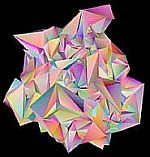 Jeremiah Zad tossed and turned; he'd been having nightmares for weeks. He couldn't think of a single reason why; his life was fairly quiet and uneventful. Twenty years ago, he came out of a six-month coma, the result of a boating accident. His rescuers told him he was found floating in an inflatable suit on the ocean, the boat or ship apparently sunk, no other survivors. To this day, cause unknown, he suffers from amnesia and, except for his name, which shone like a bright light in the midst of roiling darkness, remembers nothing of his life prior to waking up in the hospital. That's when the nightmares began, but after months of therapy and medication, they gradually went away. But now, for no apparent reason, they were back.
 He was a math professor, taught at the nearby university, stayed home to work in his garden during the summers, never went to bars or restaurants, and only once in a blue moon could be found at a museum or gallery opening. Except for his students, with whom he felt most confident, being around others stressed him out, crowds caused severe anxiety and palpitations. Usually hovering somewhere between circumspect and paranoid, he feared displeasing by doing the wrong thing. He remained apart from his neighbors, never attending parties or get-togethers, not even at Thanksgiving or Christmas. He had no friends, only colleagues, preferring instead to spend time at home engrossed in some personal project, hanging out with his cat, Dominoe. Maudlin was his middle name; chagrin his disposition. Although ordinarily attributing the nightmares to forebodings of doom, on more lucid days he saw them as either images of archetypes emerging from his unconscious, or memories long forgotten and unwilling to come forward, depending. Moreover, his preoccupation with practically every field under the sun seemed to evoke a nagging sense of abandonment, as though the two were somehow connected. However, Jeremiah Zad was about to step beyond himself into a world he couldn't imagine; the source of his mysterious nightmares revealed.
Earth Only? According to their convictions, the Stone Age of ten thousand years ago never happened. And the dinosuars lived some time within the last 6,000 years. Apparently, they see 6,000 years as being a v e r y l o n g time indeed. So, forget paleontology, geology, archeology, cosmology, astronomy, physics (the half-life of what is 50,000 years?), just about any field you can think of. Forget the teachers and field workers, forget the fact that all these disparate areas of knowledge dovetail like a giant jigsaw puzzle of the mind, coalesce into one whole dynamic picture. Poof! Gone. No need to worry about it. It doesn't exist except in the minds of the ignorant, the countless hundreds of millions of ignorant, and throw away the hundreds of millions of books that talk about such nonsense to boot. A very simple reality, uncluttered by rational thought and common sense. These are the people running the country, affecting our lives. Shades of the Holy Roman Empire, the Inquisition, the Dark Ages, the Nazi book burning craze, the Chinese so-called Cultural Revolution (irony of ironies), the Sovietization of indigenous cultures and suppression of intellectuals -- the list extends in every quarter. A struggle has been going on since the beginning, a fight that's won only in tiny pitched battles here and there. Self-righteous ignorance and denial of reality. The cause of all evil befalling humanity. The source of hatred and cruelty and bigotry and selfishness and greed. A refusal to imagine a world of sense and genuine purpose. With all peoples working together towards a common goal -- survival. Not of the fittest or the best adapted, but of the human race itself. Each of us needs to choose a side.
"For what, in the final analysis, is morality but the command of conscience seasoned by a rational examination of consequences?"
Click image to the right for larger version ... →
***************************** empty purpose doth bemoan, crumpled, futile and alone, forlorn, nay, still as stone,
packed with others of his kind,
when hope has reached the bottom rung,
to know again the purge of grime,
***************************** Note to Self: When using the outhouse at night, make sure to close the lid before reaching for the flashlight.
***************************** visiting a close friend after weeks of solitude... resonance of thoughts and images emerge... personality expressed as though undiscovered country... rustily and with surprise... by mingling thoughts and feelings... by doing things together... by agreeing about something not imagined before... and disagreeing as of before... by exploring life... by grounding to share completeness... to know self by losing that sense... to feel stronger in belonging... the resonance of friendship helps to see... to ride the currents of a world forgotten... when left too long at bey. em> reality. We can't help but be geocentric, projecting and imposing our understanding of how things work onto the universe. The Copernican revolution has not yet come to an end. If we can imagine that how we see things may not be the only way, that the human universe is not the only one, then, possibly, a new mode of questions might emerge the answers to which might elucidate the blind spot.
***************************** "Mother Earth, lately called Gaia, is no more than the commonality of organisms and the physical environment they maintain with each passing moment, an environment that will destabilize and turn lethal if the organisms are disturbed too much.""Humanity coevolved with the rest of life on this particular planet; other worlds are not in our genes." -- from The Diversity of Life by E ***************************** Click image to the right for larger version ... →
In the picture, the yellow dots respresent known satellites, the red indicate predicted faint satellites, and the blue, predicted dark satellites. The cone is the area surveyed by the Sloan telescope, our galaxy is just off to the left of its apex.
In the same edition there's an article on the Higgs boson. Here's a quote by Fermilab theoretical physicist, Bob Tschirhart, I thought was interesting: "There's a layer of existence out there we haven't discovered." Really. Physicists speculate on what is referred to as an "energy desert" existing between the realm they are able to probe now and the realm of new physics on the other side. As well, they speak of other levels of reality. If we include the current theorizing on the underlying nature of space and time, science seems to be on the verge of discovering worlds that have only been imagined in the contexts of science fiction and magic. Within the fields of cosmology, astronomy, and particle physics, in particular, a major upheaval in the universe of thought concerning the nature of everything is in the offing. For example, the ingredients we have assumed necessary for life to exist may not be all that necessary. Nature coughs up its secrets through application of our cognitive faculties, based on the questions asked. So, our knowledge is constrained and fashioned by our humanity which limits us in our perception and understanding, how we filter and interpret reality. By so doing, we humanize reality. We can't help but be geocentric, projecting and imposing our understanding of how things work onto the universe. The Copernican revolution has not yet come to an end. If we can imagine that how we see things may not be the only way, that the human universe is not the only one, then, possibly, a new mode of questions might emerge the answers to which might elucidate the blind spot.
***************************** "Mother Earth, lately called Gaia, is no more than the commonality of organisms and the physical environment they maintain with each passing moment, an environment that will destabilize and turn lethal if the organisms are disturbed too much.""Humanity coevolved with the rest of life on this particular planet; other worlds are not in our genes." -- from The Diversity of Life by Edward O. Wilson
Comment On another planet, however, there is no reason to expect this congruent immersion--energy forthcoming by virtue of the equivalent invariances being present. We base that supposition on the mistaken belief that all life is as we know it, that the DNA molecule is the source of life and no other arrangement is possible. Life will find a way with whatever ingredients are available and by any means. Not only by substituting other chemicals in the double helix configuration we're familiar with, but by a whole other form. We can't know now how that would effect living things on some other planet. Thought processes. Could we even communicate other than through mathematics, assuming their understanding and perception of the physical laws of the universe are the same? There may be physical relationships and forces which we are not unaware that intermix in ways only a being constructed completely differently can see.
***************************** HIPPY-OUTLAW-FISHERMAN-HIPPY-OUTLAW-FISHERMAN HIPPY-OUTLAW-FISHERMAN HIPPY OUTLAW FISHERMAN
I went to ANCESTRY.COM and discovered that my great, great, great granduncle had been a bank robber in Texas. He was caught and given a 30-year prison sentence. While trying to escape, however, he killed two guards, and shortly afterwards -- it was Texas -- was hung by the neck until dead. Who knew? My uncle, the bank robber. How romantic.
*****************************
***************************** Mushrooms and Falling Leaves It was autumn in Massachusetts, a sharp invigorating sunny day. Everything seemed to be outlined in pencil, then colored in. The air held that sweet pungent aroma of dying leaves and fungus. I was wearing a knee-length cashmere coat, dark blue; a scarf a friend had given me; and suede cowboy boots. I was visiting folks, a married couple, and to give us all a break, I decided to go for a walk in the woods nearby. Resplendent in all the colors of the rainbow, leaves were falling ever so slowly, dreamily. Pursuing the burbling sound of running water, I came to a stone arch-bridge over a fast-moving creek. Stopping in the middle, I leaned on the flat stones facing downstream, miniature rapids splashed playfully over sleek sculpted rocks, carrying twigs and leaves out to sea. Off to the left, I noticed a gravel walkway, barely discernable under leaves, snaking along the bank. About fifty yards down I saw a man and woman standing together, talking and gesturing agitatedly. Concerned, I stared, believing they had no thought of my presence. Suddenly the man pushed the woman towards the creek, the bank just ten feet or so away. Maintaining her balance, she pulled a rod-like object out of her purse and inserted it through the center of a two-inch disk. A faint clicking noise followed. The man shrank into himself, his voice, conciliatory. She laughed, then, extending the object towards him, spoke words in a heavy sing-song tone.
limited by those things he could imagine
order and complexity relate to function
suppressed or amplified
the next step in our thinking
It just might be true that human beings are composites of all other living creatures, flora and fauna. Forty years ago I started looking at things in opposite ways in an effort to see if blending those opposite perspectives would reveal an inner commonality, and their synthesis force a new, higher-ordered reality. Being mathematically inclined, I first considered the idea of a geometric point, a given in Euclidean geometry, as an empty--zero-dimension?--and less than helpful fabrication. Instead, what we call a point I redefined as an intersection of a finite and fundamental subset of lines--a basis--each one standing for a separate aspect or point-of-view. We thereby jump from a zero-dimensional point to an infinite set of intersecting one-D lines. And then there was string theory. Hence, my assertion that we each need to contact our inner platypus and cease trying to find our heads. We may actually be everything else, and our pointy heads just a fabrication.
***************************** Gene or Expression?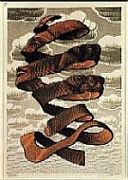 What came first, the gene or its expression? If the gene, then it had to know in advance what expression was needed. And if the expression, it had to create a way to duplicate that function/process/thing by stringing together a sequence of molecular nucleotides and inserting them into the existing genome. Are they two different aspects of a single entangled biochemical phenomenon? Elements of two entirely different classes--the information to make or do something and the thing itself--coming into being simultaneously? Rational reduction, separating a connected process into two distinct phenomena, is a reality only in our minds. So, what is going on? How does the blood know to coagulate and also how to do it before the need proves important and necessary? Do they both happen at once? Who's orchestrating this fandango?
 Life is not a non-sequitor. Life is not something planted here. Life is not an intruder. It's indigenous, ingrained, innate, the inner psyche reverberating through all the Earth's living parts. If every creature on the face of the Earth--flora and fauna--were to suddenly and mysteriously vanish, the Earth would regenerate itself. It embodies life as a fundamental principle and characteristic of its restless and creative nature. The entire solar system operates as one grand nursery. The sun; the outer planets, protecting the Earth from falling debris; our place in the galaxy, everything works to bring about life growing through the Earth. And we are not separate from it even if we wanted to be. Our principle identity is that of something grown by the Earth, an earthling. We are not, therefore, a special creation. Humanity operates under the presumption that to plunder the Earth and devastate its other creatures, without knowing much about their roles or what benefit they may be medicinally, won't come back to bite us. There is no evidence to warrant that belief. We are disconnected from the Earth. We don't know our place, we don't know what we're supposed to be doing. But one thing is for certain, the Earth presses towards symmetry, balance, and when things have gotten too far out of hand in the past, it's taken all the clay, rolled it up into a big ball, and started all over again; altering its expression, stripping away the old, setting the stage for a whole new order; same story, new characters; same symphony, different orchestra. The Earth has its own agenda. Asymmetry is the natural proclivity of evolution and the consequence of Earth's motility and dynamism. But symmetry is the aspiration, the energy siphoned from surroundings, channeled and organized, the counterpoint to entropy and asymmetry. Symmetries of wholes--individual organisms, ecosystems, hierarchies, natural orders--are continually being worked towards. And while such is sustained, we have the semblance of stability and equilibrium. But Life exists on the edge of chaos, far from equilibrium. It resides in that irresistible asymmetric pulse; the balance achieved is in the realm of wholes. The asymmetric pulse breaks the symmetry, forging a new direction for the whole, a revised adaption to environmental pressures. Evolution, both of living things and the Earth-Solar system, is unstoppable and relentless; change inevitably occurs, a threshold crossed. Individual asymmetries within a system co-evolve. If this web of niches is healthy, the whole transforms in a mutually beneficial way, integrated functionality moving forward along interdependent trajectories in time and space. Drastic change affecting all might come in the form of a one-time event, like an asteroid or volcanic eruption, or a sudden shift as the result of tiny alterations here and there gradually building-up over eons in a subtle, nonlinear, interdependent way, eventually reaching a critical state. And between wholes, a tectonic arrangement demarks the play of order and disorder at the fault lines, the boundaries. But when ill health, decay, or overwhelming environmental circumstances prevail, a system, regardless of scale, destabilizes, disintegrates, and implodes or locks-up and stagnates, resulting in terminal breakdown for each individual component composing it. This finality is an extinction event. It's how the Earth carries on, given the principles of nature for which it stands, and it does it well. The Earth is both source and conduit of life-force. And despite humanity's stubborn arrogance, it functions independently of our wishes and desires. The Earth grew us, that's where our primary allegiance lies. We are obligated by ties that run deep. Caring about the Earth is what we're supposed to be doing; elsewise, it might stop caring about us. It might see us as a dangerous infestation that needs to be eradicated, for the good of the whole, or beyond that, it might simply roll up the whole ball of clay and start all over again. That act of cleaning the slate may already be in the works, deceptively slow and randomly piecemeal, but we're too busy killing one another and trashing the planet to notice.
I was going to say the Earth corrects towards balance, but that's engineering terminology. It infers or connotes something mechanical going on. But the Earth doesn't react mechanically; its being lies in the act of continuous action. Hence, the energy--the mysterious life-force--needed as input, to be applied towards physical manifestation, as a sculptor would, from the tiniest molecules on up, to produce and maintain the vast complex of earthly biodiversity, the variety of dissipative systems we call living organisms.
A feedback loop inextricably links the biosphere with the rest of the Earth-Solar complex, negative feedback in counterpoint with positive amplification. Cyanobacteria generated enough oxygen to bed raw iron and thereafter allow for the emergence of animals. Were animal designs in the playbook from the very beginning? Preordained? Just because there was a higher percentage of oxygen in the atmosphere 600 million years ago, did that, combined with other conditions, mandate the rise of animals? Evolution is not blindly charging forward willy-nilly in all directions at once, hoping something will stick. Were beings capable of self-awareness purposefully grown by the Earth so it may know itself? Is that life's drive and direction? Conditions and circumstances set the stage, amplification homes in on its expression, a resonance in biospace traces a schematic, draws manifestation from available units, builds a hierarchy of regulation and modification--a chord is struck whose origin predates its supporting circumstances. What came first, the gene or its expression?
*****************************
The Phillips Collection
***************************** Thought TrainA Real number is a fusion of complex conjugates. When we probe more deeply into the real spatial basis of a solution, we reveal another layer, a pair of opposites the union of which defines the symmetry of the Real number. As though looking through a magnifying glass, we impose the Complex field onto the Real, and thereby force the solution to expose its inner composition. Is the Fourier series of a set of conjugate possibilities somehow related to factor groups? Is the parent group equivalent to the quantum wavefunction? Special functions, like the Hermitian and the Bessel, are generators along mathematical trajectories of the coefficients for each distinct eignevector. And as such, can be considered to create a geometrically nested series. The modulus of the parent group over a maximal invariant subgroup produces a simple factor group. By simple is meant nondivisible--a whole unto itself--and invariant or geometric. Is a factor group of a composition series equivalent to an eigenvector of a Fourier series, an invariant basis element? The Real number is equivalent to the parent group is equivalent to the wavefunction. On deeper levels, reality begins to run into itself; the boundaries, ficticious and provisional to begin with, lose their rigid certainty and, at first, become porous. Deeper still, the superficial differences melt away revealing the background connectivity, the singleness of identity. Could that be a basic principle of life as well as of mathematics?
"The domain of species are invariant subsets and there are partitions of these sets that define genera, families, and so on, corresponding to hierarchically related invariant subsets." From: How The Leopard Changed Its Spots, page 113, by Brian Goodwin.
Breakthroughs There have been many such breakthroughs--innovations--as evolution has turned, twisted and leapt its way along. Based on existing circumstances at the time, none could have been predicted. So, how did they come about? What was the generative force? Was an actual decision made? A new way of doing business ascertained, conceptualized, and put into play biochemically? First a design, then its reflection in material space. But why? The Earth could've gotten along just fine with only microbes and colonies of such. Why bother to expand on life? And where does the inspiration to jump to the next level of complexity come from? If it was not possible from the beginning, if life had gone down a deadend, development- and evolution-wise, would life had ground to a standtill? If evolution is not an innate characteristic of living systems, then what is the driving force behind complexity? The Earth and life-forms dance together. Life-forms alter the Earth, including, significantly, the atmosphere, and in turn, the Earth creates opportunities for life that didn't previously exist. Taking the long view back in time, the breakthroughs played a critical role. They were not mere blips on a continuous string of cause-effect functionality. It's as though they were preset threshold events that simply had to happen. Evolution, as a principle of nature, adapting to punctuations due to cataclysms, guides life along a step-wise chain of events, poised to take advantage of any empty biospace, spontaneously forming interconnections which, in themselves, expand on life geometrically. How does it know to do that? And by what method? What's the procedure? What does it do first? I am not a creationist or intelligent designer. Nonetheless, I can't shake the feeling that evolution is intimately intertwined with an inner intelligence beyond our capacity to grasp. It may simply be a force our limited minds can't detect or even imagine, so we call it God. I don't know; it just seems to have to be that way.
"Why seek the miraculous and supernatural beyond life?" From Tertium Organum by P. D. Ouspensky
*****************************
*****************************
Cordova, Alaska My home for six years when I was a fisherman.
***************************** Are We Insane?I feel like I'm living in Medieval times.The other night I watched a documentary on using chimpanzees for medical research, experiments, and stress testing, among other despicable things. Only a sociopath could engage in such activities. It raised my awareness. Afterwards, I researched and discovered other disturbing related practices occurring worldwide. Here is a sampling of what I found; more is on my Global Digest page at: Animal Cruelty - Animal Testing.
Preotecting the Rights, Welfare and Habitats of Animals
by Michael A. Budkie
Advocating for animals to live and live free without cruelty and neglect
***************************** The CleanerHe was from another planet; it was obvious. No one that smart and that good looking could possibly be from Earth. After being elected President of the World, he initiated mandates, proclamations with the weight of law: It was against the law for anyone to go without at least one good meal every day. Hunger was abolished. Pharmaceutical companies were ordered to research the worst diseases of humanity. They were no longer to waste time and money on lifestyle drugs, health became the priority. Big-city gang members, not only well-known by the police, but also not terribly secretive when it comes to advertising their gang affiliations, were rounded up worldwide, taken to their respective countryside, shot, then buried in mass, unmarked graves. This radical exercise worked to discourage future gang formation. The killing of animals for sport or profit, especially those on the brink of extinction, and the abuse of domestic animals was punishable by death; euthanasia, it was called. A moratorium was placed on all logging endeavors, no matter how small. Habitat loss was considered particularly heinous, its contributors were summarily executed. The ecosystem as a whole-unto-itself suffered from a bottom-up perspective. Procedures and protocols were put in place to correct the situation. Bureaucracy transformed almost overnight into a system impressed with fresh conduits of information transfer, social engrams that superseded previously ingrained manners of thinking and behaving. All religions were banned, anyone found practicing a religion were summarily executed. Polluters of air and water were forced to breathe and drink the poisons they dumped into the environment; the worst corporate offenders were simply shut down; the days of the token fine were over. Recalcitrant leaders of industries deemed detrimental to the health and well-being of society were put to death on public television. This seemed to encourage others to clean up their act. After it was discovered that poor nutrition--the result of toxically tainted food caused by irrigation with polluted water--was the main cause of cancer, heart and liver problems, brain tumors, and serious mental disorders--those that inevitably lead to violence--the quality of water became the highest of priorities. When the social ramifications of continued neglect of this life-sustaining resource--like war--were demonstratively realized, technologies to purify and protect it rapidly developed. He instituted other controls as well, and everyone did as he requested; he was that charming and persuasive. It should be noted, however, that his people back on Xulcatur in the Andromeda Galaxy have the capacity to rearrange the interconnections of synapses in the brains and hence minds of lower-ordered sentients. During the Golden Age of exploration, his race had recourse to use this ability on many confused, ignorant, and volatile populations in order to gain cooperation, for their own good. On Earth, he applied this talent to its fullest potential, greatly enhancing his persuasiveness. As well, his race had long since gone through its adolescent stage, past middle adulthood, and into the space of genuine understanding. Life, to them, was to be lived and enjoyed for its own sake, and this level of appreciation was to be spread around and the importance of the message instilled from birth. The inclination and predisposition for strickly self-centered action that denied the inherent value of others--sociopathy--had been neutralized over successive generations by natural selection. Like a tree across the road, advanced common sense prevented preying on, exploiting or bullying others in much the same way that a normal person would balk at deliberately dropping a heavy object on his foot. Only a moron would do something like that; consequently, morons were systematically eliminated from the gene pool. It was his intention to do the same here, on Earth. Everybody with a brain in his head agreed.
***************************** it was his resistance to and fear of self-audibles, his inability to change horses in the middle of the stream, his unwillingness to let go the ties that bind, to be one with the present, to be truly free that gave him the mandate from God to be free by force of will, but in time, the pendulum swung, the illusion evaporated, God disowned him, humanity gained an upper hand, he ended up on his own, an aloneness he sought not, free at last, as life would only have it
The mind-set of holding on to what you got is a defensive posture that's doomed to collapse in failure and loss. Restraint due to fear of consequences of actions and words spoken when in defense of that which and whom we love can only come back to bite us on the ass. We know in our minds and hearts what we need to do, what's right and what's wrong; we gain nothing by holding back when it matters. I don't mean you should tell your landlord off and get thrown out on the street; the buoyant feeling of righteousness will only last so long, then the hard cold practical reality will kick in. No, nothing so stupid and irresponsible, and, I must say, petty and meaningless. I'm referring to self-respect, valuing your life. The kind of self-respect that can only be realized and find fertile ground to grow when respecting others. Being a gentleman is a cultured discipline the instinct for which should come naturally. It has to do with maturity, consideration, and the appreciation for a certain quality and aesthetic of life. Being as smart as you're able in a clear, sober, unobtrusive way can open the door to fearlessness and freedom. To respect our highest intelligence is an affirmation of the best that's in us. And by so doing, the state of mutual respect--communion--becomes more important than our separate selves. Caveat: Of course, if you're being treated with disrespect and contempt--or worse--by someone, you're under no obligation to strive for or honor said communion.
without you so much q u i e t so deep so everywhere the kind that makes time s t r e t c h on to an infinity of wishing you were here
***************************** May 16, 2012 The weather's been warm and sunny the last few days, all of a sudden. That's how it is in the Northwest. I awoke around 5 A.M., and because of the quiet and cool softness of the air, my mind wandered to another time and place. It wasn't hard, I've been thinking about the past quite a bit lately.
It was early morning. I was on the back deck of a boat, anchored somewhere in the northwestern part of Prince William Sound, Alaska. It was summer, July, the air was incredibly clean and crisp, due mostly to the abundance of glaciers and small icebergs floating about. I was sitting on the hatch-cover looking out at the beaches, the glaciers, and the snow-topped Chugach Mountains all around. Because the northern part is all fiords, it can be sixty feet deep right up against the beach with the trees hanging over the water. Jerry, my good friend, and I were smoking a joint and drinking coffee. It was quiet, an occasional seagull called. We smoked and sipped and listened in silence, feeling the sun and cool air. Good times.
***************************** The Science of Neuroplasticity
Lately I watch a lot of TV and can't help but see this ad for memory enhancement under the guise of neuroplasticity. What the hell could that be? As near as I can figure out, the process somehow prunes lifeless connections and regenerates, if not creates from scratch, synaptic webs. A tune-up, restoring the engrammic landscape to its former glory. We knew how to learn in school--most of us did--where the original schematics for brain engrams were laid down, etched, engraved, and maintained through practice and by building on the fundamental understandings. Then life happened and we no longer, for the most part, needed to be that sharp, to remember that well, with that depth. Sure, small sub-webs not related to profession, pastimes, and survival continue to function satisfactorily, and stitched together can fashion a fairly good picture of what we're experiencing, but only piecemeal and as a vague overview, like witnesses' reports of what just transpired in front of their face. Neuroplasticity--rearranging, reviving, and creating synaptic patterns--covers a range of processes, from applying ourselves to understanding difficult mathematical problems by holding several variables and parameters in our minds simultaneously, to seeing, while participating in, what's going on in front of us with as much detail as possible. These mental images are reflected biochemically in the form of an engrammic impression, a web of living nerve cells. Plasticity is the opposite of rigidity, habit-energy. So, even just accepting that a science called neuroplasticity exists and expressing an interest in seeking its help destabilizes the confinement of rigid thinking and causes us to refocus our energy and to see, with the intensity of present attention, how incredibly intellectually lazy we've become and what we can do about it.
On the serious side, however, isn't neuroplasticity what learning and the effects of propaganda, indoctrination, and socialization are all about? Isn't that what happens when we're confronted with a novel situation? When we feel a new feeling? When we think a new thought, experience an insight or a novel idea? Einstein's plasticity allowed him to question basic assumptions--accepted conventions--about the nature of time and space and gravity. To explain his novel ideas, he had to learn a new geometry. We are forever re-plasticising our brains by adapting to new circumstances and personally evolving and reappraising our selves. Our brains, through neuroplasticity, deletes old connections as frequently as it genrates new ones, either allowing synaptic pathways to fade away through lack of use or by increasing the density of patterns--preserving and strenghtening--through attention, learning, and memory. The bottomline is: we have to want to see and to remember; the effort has to be made. That's the science and the juju of it all. Prolonged periods of depression, doubt, and self-flagellation tend to organize and emphasize pathways that cause us to forget the better side of ourselves. We may have spent years of our lives doing things that required unusual abilities, skills, and knowledge as our self grew in size, scope, and complexity that a continued state of depression works to eradicate from memory. Or we may be lost in a constant state of rage about being mistreated and abused, thereby drowning out any feelings and states of mind having to do with happiness or the simple joy of being alive. What we dwell on reshapes our brains accordingly. A few years ago I experienced something I consider to be personally tragic--the loss of a loved one very close to me. Afterwards, I dwelled continuously on my role in that event. But, in spite of the ensuing depression and loss of self-respect, something strange happened. I began a process of remembering who I am, a person I had previously lost contact with through years of wishing I had made other choices in my life, regretting the abandonment of who and what I could've been. I no longer think about that. Somehow, that train of thought has been broken.
Thinking thus once generated not only depression, but also anger towards myself. Initially, it worked against me, an anger that further served to undermine me. But I saw that somewhere along the line, I'd put myself on hold while submerging my heart and will in shoulda-couldas. In the process, I lost independence and control, gave it away and settled for a subjugated life, a life enveloped and infused with strict lines of behavior, isolated, while I used up the little time we have thinking about yesteryear and where-oh-where did it all go wrong. I redirected that anger. At some pont, my mind/brain went to work remembering that former person I used to be, that man for whom I had respect, and how important living in the present for the present was. How it used to focus my energies and gave me the will to act. But now on a much deeper level, tying in other parts of myself, what I've learned and what I've jetisoned, taking a cold sober view of what has meaning right now, this life. [Obsessively sifting and analyzing the past in an effort to find what's holding you back from living fully in the present is self-defeating madness. It's the obsessive analyzing that's the hold-up.] A coming to terms with faults and weaknesses of character, with ingrained psychological and emotional tendencies and shortcomings, to seeing and accepting them while working to overcome them and neutralize their influence. I need to be that person, with all his imperfections, and to no longer try to sabotage him. I just don't have the time. Neuroplasticity: Reviving and reshaping the positive and real while simultaneously abandoning and pruning the detrimental and delusional. What the mind thinks, the brain maps. And the re-mapping of the brain changes the mind. Constant feedback loop. Or, as Thoreau once wrote: "What a man thinks of himself, that is which determines, or indicates, his fate."
"The intricate relationship between structural brain connectivity and functional brain activity is an important and intriguing research area. Brain structure (the pattern of neuroanatomical connections) is thought to strongly influence and constrain brain function (the pattern of neuronal activations). Concurrently, brain function is thought to gradually reshape brain structure, through processes such as activity-dependent plasticity (the “what fires together, wires together” principle)." From a research article on self-organized criticality in networks of spiking neurons: PLoS Computational Biology
Introduction to Neuroplasticity And what role does epigenetics play in neuroplasticity?
Epigenetics
"The history of science is rich in the example of bringing two sets of techniques, two sets of ideas, developed in separate contexts for the pursuit of new truth, into touch with one another." J. Robert Oppenheimer ***************************** Bertrand Russell was, among other things, a linguist and a mathematician. He seemed to believe that if certain words were put in a certain permutation, the logicalness of it would yield truths and insights previously unrecognized and unanticipated. In mathematics, the proper, or accidental, arrangement of parameters and variables does the same thing. Witness Einstein's and Schrodinger's equations. We read a permutation of words where the author happens to say something in just the right way--hits the nail on the head. Immediately, a clicking sound reverberates through our brain, aligning engrams just so, and we say, Yeah, that's it.***************************** AmericanaBlood splattered across the kitchen table, followed by the hugging couple. Shattering plates and cups added to the din of the front window exploding. It all seemed to happen in slow motion. Uncle Frank reached for the shotgun above the door, but as he grabbed it, bullets splintered the old wood, sending him reeling backwards. Falling flat, arms out-stretched, hands empty, he lay still as stone. Billie, his 12-year old niece, cowered in the corner beside the stove, petrified, tears streaming down her cheeks. They'd known it would come to this sooner or later; they had only themselves to blame. In Pocamocha County, not returning library books was a capital offense. And they'd already been given final notice. Life is harsh in Pocamocha. And the library police take their job very seriously. With passion and an almost religious fervor, they carry out the law. And the law dictates punishment. Their code states that anyone who'd steal books from a library has no reason to live. Yes, life is rough in Pocamocha, but that's how they like it. [In the sophisticated capital of Iran, Tehran, a girl who made the mistake of having a boyfriend from another tribe (neighborhood) was stoned to death in broad daylight by a group of grown men while a policeman stood nearby.]
*****************************
***************************** Responsibility and Self-DelusionDetails. Details set the pattern, paint the picture, organize the parts, but we often overlook them for the sake of the whole impression. Nonetheless, if we are sensitive enough, the tiniest dissonance registers. And even though we may not be able to spot its cause, we feel it, a discomfort, an emotional asymmetry. It's like a grating on our skin or a smudge on the window of our perception, a sound out of sync with the rest of the orchestra, a cold draft coming from who-knows-where. As I understand it, major breakthroughs in thought are the result of intensely scrutinizing the details--a tunnel vision focusing on the underpinnings of our construct--and seeing a preconceived notion that may be unreliable or downright falacious. This structure includes conventional assumptions as to the nature of that which we study. We work with the structures of the mind handed us by those we trust to have more knowledge of the subject than we do. Einstein was handed Newton's version of gravity, space, and time. Details? Einstein questioned the validity of Newton's assumptions, and discovered a clearer understanding of the true nature of the universe. Some day, perhaps, his understanding may be revised. When we look inside ourselves for reasons why we committed an act that turns out to have unfavorable conseqeunces, we're met with an infinite regression of egos, one nested inside the other. Reflecting on similar experiences that occurred at different times in our lives in order to see the common cause, the flaw, the learned faulty reasoning or habit of reaction becomes a neverending obsession, without resolution or sense of finality. We never really arrive at the bottom of it with the necessary feeling of satisfaction. Intellectual explanations are usually tainted by the sense of something vital missing. Invariably, the logical end is a loss of faith, a collapse, spiraling ever inward. And, if our attempt to understand is actually a mask for a desire to rationalize away responsibility, we are doomed to failure of the most important kind--to accept who we are, fallible and imperfect. That's the detail that's often overlooked, the cause of dissonance, and the impediment to growth. It's the nature of the ego to absolve itself of all wrongdoing, to abdicate responsibility with some lame, ready-made excuse. So going through the medium of the ego to try to grasp the cause for an ill-conceived act resulting in an undesired outcome is foolhardy. Accepting responsibility for mistakes (everybody makes them) means abandoning arrogance and ego-centeredness. To think of oneself as incapable of screwing up is pure madness and childish. There's a point--a state of mind--where time slows way down, we let ourselves feel our surroundings (which sometimes demands a great deal of courage), open and vulnerable, unafraid to do so and unneeding permission. At that point we have the opportunity to realize that to be so is both our reason for being and our birthright as creatures of the universe. No one has the right to deny that to us or to take it away by any means. If we choose to ignore the details that block that identity from emerging--and we know what they are--we inadvertently deny ourselves the possibility of discovering our destiny, as though refusing to accept it out of a deep-seated feeling of unworthiness. Once asserting that kind of independence and autonomy--metaphysical and physical--we're on our own, making active decisions from moment to moment, choices for which we have accepted full responsibility--the ultimate detail. For better or worse, it means the end of dissonance.
Blunt Commentary We lost faith in the way we learned when children, whether religious or some sectarian credo, found this, misunderstood its finer features, and now end up, by dint of experience, questioning and doubting our new found ego. Only we don't see it as an ego, we imagine we are freed of such petty hallucinations. But it's just another prison. Freedom lies down the rabbit hole, the way down and out, sliding through the middle ground without restraint, without depending on and waiting for our ego to make a decison based on some cobbled together criterion--dogma, code, belief system. The ego is a prison and a load on our shoulders. Just thinking about it opens up a Pandora's Box of misdirection and egos demanding attention and identity. It doesn't want us to see it objectively, as something conjured by the psychic energy of our mind. It wants control, no second class designation for it. Love is the key. The ego is defenseless against it. They live in different realms. It's a connection and as such has a life of its own. In order to realize this fully, the ego must be banished, turned to smoke. So, we don't get off scott-free, we must act and with effort to forge connections with others and with nature and with life. To the degree that the connection is strong and open, the ego's strength is dimished. It's a choice that involves fear and insecurity until known and accepted as the way down and out, the only real choice.
"On Sartre's view, the inescapable condition of human life is the requirement of choosing something and accepting the responsibility for the consequences." “Man is condemned to be free. Condemned because he did not create himself, yet is nevertheless at liberty, and from the moment he is thrown into this world he is responsible for everything he does.” "True freedom lies in accepting full responsibility for the consequences of our actions."
Responsibility and Freedom: the foundations of Satre's concept of intellectual engagement -- PDF File
Quotes About Responsibility
Spring In The Northwest He waited for the door to open, but no sound came, no telltale sound of a door opening. As though an electric current immobilizing his body had been shut off, his muscles relaxed. Tossing the blanket aside, he stood; blood rushed to his arms and legs. He went to the door, pushed it open and poked his head out. Nothing. Stepping onto the wet grass, he scanned the area. Still nothing. Birds chittered and sang. The miserable rain fell. Even the air seemed morose and weary. Closing the door, he returned to bed and blanket. Staring through the bleary, rain-streaked window, he watched for the signal to act.
And Now For A Little Math Of all quadrilateral prisms with a given volume, the cube has the least surface area. A cube is defined as a regular quadrilateral prism. By using the reflection principle we are able to increase the area of an irregular figure without increasing its perimeter.
All mathematical processes can be characterized in terms of maps. For example, the polynomial equation--ax2 + bx = 0--is the basic question that maps to its set of solutions or roots. Any set of questions which renders the same answer must be the same question--multiples. Therefore, this basic equation, or invariant vector, is a particular aspect of a mathematical system seen as a component of symmetry; the fundamental equation of the equivalence class generates the system, and so acts as one of its mechanisms. Algebraic analysis answers questions and seeks information about form and structure, general principles or invariants, by eliminating redundancies and testing for common ground, fine-tuning characterizations. Every algebraic structure has at least group symmetry. Galois demonstrated that, in general, the quintic (fifth degree polynomial) is not solvable by ordinary means. There is no fifth degree symmetry; the splitting of conjugates (the roots of the equation) is not complete. There are, of course, many exceptions to this rule; however, we are not interested in those. The symmetry group, S5, containing five factorial (120) elements is the group of permutations on the roots of the quintic. In order for a group of permutations on the roots of an equation to be solvable and the associated equation reducible, each factor group of its composition series must be simple (invariant and nondivisible) and abelian. The quintic series is {E, A5, S5}. A5 is the smallest non-abelian simple group and is referred to as the alternating group, the group of even permutations. Additionally, the factor group, A5/E, is isomorphic to A5 and is therefore also non-abelian simple [An isomorphic map preserves invariant, geometry-defining features in one-to-one correspondence. (Felix Klein)]. That's the basic theory. From another perspective, in the case of the quintic, on the fourth dimension we have an autonomous component. What does this mean? The central axis of reflection has no inverse element throughout; only if each factor representing the quintic were abelian (commutative) would that be the case. Imagine these factors as solid objects composing a structure with a center of gravity. The first three dimensions would balance, but on the fourth we have an asymmetrical extension jutting away from the main axis necessitating a counterbalance. Thus there is no single generator of the whole group. Or, there is no 5th degree symmetry of the type with only one central axis. So, we have an asymmetric configuration for which we need an imaginary reflection. The Complex Field is a two-generator [related] form of symmetry. While the real part generates the asymmetric component, the imaginary part generates the opposite or reflective component [or should I say: 'reflective asymmetry aspect'], and by so doing imposes symmetry. It is not a function if it does not define. The definition of a function is that of the definer. An equation defines an equivalence relation on a set of elements, say, numbers. The Identity equivalence class of the quintic is undefinable without relabeling all roots against the background of the two-generator symmetry system--the complex numbers. Considering the irreducible polynomial for which there is no defined Identity equivalence class over the field to which it is restricted, in order to reduce it (solve it) we must relabel to make the environment compatible for the prime factor. In actuality, we are applying more restrictions to our base field by dictating the form each number must take. We thereby garnish more information by taking this peculiar point-of-view of the irreducible. Phase shifting or twisting compared to hyperscaling. It increases the fundamental unit by one full dimension while still allowing for supersymmetry. [The Complex field is actually a higher-ordered symmetry, not just the result of adding one independent vector to the Reals.] 1) Reducible polynomial has axis of symmetry bisecting root segment, roots acting as end points or conjugates. 2) Non-reducible polynomial needs phase mapping: b maps to b(irr) Like a planar projection, in order to align reflection symmetry plane. You have no group without reflection symmetry for each element. 3) In Complex space: Each Real number is composed of two complex conjugates. Imaginary symmetry is an increased gradation of magnification, and therefore reveals the Complex number field within the Real number field [as in: atoms, nucleons, quarks]. Therefore, any Real number solution to a polynomial, reducible or nonreducible, has a conjugate. All complex solutions, or roots, come in pairs. A number--A--in the Real realm can be written as A + 0i in the Complex. But... Caveat: When two different forms are said to be equivalent, it does not mean they are equal, that one could be replaced by the other, but rather that they each represent the same aspect or position in the overall symmetry of quite different, yet isomorphic, realities.
* a + b(irr) points to axial symmetry with planar shifting. a + bi points to increased magnification symmetry of internal structure [or from the point of view of internal structure]. Or, in much the same way as a gauge aspect is included to artificially manufacture symmetry. If the two are the same; that is, if the irreducible (irr) is x2 + 1 = 0, then we have both a deeper level of reality as well as planar shifting.
***************************** Really Important StuffBy an imperceptible sleight of hand, the center of his being, his mind, his very soul slipped from 'going out to life to know it' to 'going out to life to know himself'. And nothing was ever the same again. Don't give your life to the Church, the State, your mother, anyone. If you're not free of encumbrances and false obligations, if you submit your will to something unreal or refuse to grow passed the womb-space of mom, you will never be able to experience life fully, you will never know yourself truly, you will never put love for another above selfish interests, and you will never enjoy iced-tea on a hot summer day the way it's meant to. We ran at night through the field of icebergs coming out of Columbia Bay, in the fog, without radar, using the Loran and compass to steer by. We had a man on the bow watching, giving directions with hand signals. Read The Walking Drum by Louis Lamour.
I've been spending an inordinate amount of time alone lately. This morning I was telling my cat about something that happened yesterday. When I finished, he gave me a long hard look, then sauntered out the door. I haven't seen him since. I put bread out for the birds, a habit I got into a long time ago. My grandmother used to feed the pigeons stale bread back in Philly. I sat with them while they ate, picking and tearing the small pieces apart. They come in twos and threes, hopping around, occasionally glancing my way. I told a threesome what occurred this morning with my cat. An impressively-jacketed robin looked up and said, "Good riddance." At least it sounded like that, could've been something else, I don't know. My hearing's not what it used to be. They don't say much ordinarily, but once in awhile you can't shut them up, especially when I'm late with the bread. I went back inside to see what was on television. There was a movie about werewolves killing one another, not much else. It was impossible to tell who was on what side; werewolves all look alike to me. And they're constantly growling, always. Makes you wonder what werewoves do when they're not growling and ripping throats out. Sitting around playing cards, drinking, shooting hoops? I watched about a half-hour's worth and that was enough; I can only take so much bloodletting. It's the afternoon now; I think I'll take a nap. Maybe I'll dream about Lolanda.
Stephen Hawking once told me that a person could never use a time machine to go into the past before the first time the machine was used. Pretty tricky, huh? A person conceivably could go into the future the first time it was used, but couldn't return to any moment prior to landing in the future. That is to say, the whole process of getting into the contraption, warming up the drive unit--whatever that may be--saying good-bye to the cat, dialing a future date and pressing the GO button, would forever remain inaccessible. He could not go back in time before the moment he arrived in the future. But, suppose that in the future-time you chose, say, July 4th, 20,000 AD, there's no one around, nothing, just the dusty remains of a former civilization? You couldn't go back. I guess there's other things to worry about. Practical things: car breaking down in the middle of Kansas, running out of coffee, having the electricity shut off when nearing the end of writing a story on your computer. But nonetheless, suppose there's no such thing as future-time? We just assume it. Countless stories concern traveling to the future. Maybe it doesn't exist. Have ya' thought about that? Huh? Have ya'?
I've tried to get into the television show Rizoli & Isles, but it simply isn't working. For Angie Harmon to portray an unsophisticated, street-wise, tomboy is like hitching a thoroughbred to a beer wagon. She'll always be Miss Carmichael to me.
Long ago, sitting at a bar, an arrogant young punk asked me, contempt in his tone, "How hard could it to be a longliner?" He went on to say he was sure he could do it, no problem. I asked him if he'd be willing to take a test. He took a sip of his drink, and with a smug smirk on his lips, asked, "What?" He didn't say old guy but it was there. I told him to stand and hold his arms out straight sideways, shoulder height. He did as I requested, then asked, "For how long?" I took a sip of my beer and replied, "Three months."
Science Report: Thought Has A Material Base As well, they've demonstrated that thought-energy can pass through both ordinary and dark matter with the same ease as neutrinos. Unlike neutrinos, however, thought encapsulates information about the nature of the universe, and, as such, is self-organizing, complex, and capable of replicating and evolving, much like an organism. Experiments have been conducted at the Polytech's Cognitive Research facility that clearly point towards the development of a theory describing how thought can be transformed into reality on all levels of existence. Apparently, it happens all the time, we're just not aware of it. That is to say, underlying the whole of the multidimensional universe is what may be called a psychic field, the source of all that is and the well-spring of cognition. It's expected by the scientific community at large, and the neuroscience community in particular, that Doctor Gablinski will no doubt receive the Nobel prize for this work. His findings explain much, after all. They go to the heart of mysteries of the physical realm as well as shedding light on the nature of consciousness and its role in creating and shaping the world around us. Ether: Physics: An all-pervading, infinitely elastic, massless medium formerly postulated as the medium of propagation of electromagnetic waves.
"If we could change our psychic apparatus and should then discover that the world around us was changing, this would constitute for us the proof of the dependence of the properties of space upon the properties of consciousness." From Tertium Organum by P. D. Ouspensky "The thoughts that one creates generate patterns at the mind level of nature." William Tiller ---- Tiller Foundation
When Evolution Started Over We can imagine this old way--the Ediacaran world--as a thing-in-itself, a synergistic set of interrelationships, a context without fear or the need to develop strategies for survival beyond simply being and growing. But at the end of the Ediacaran Period--what marks it as the end--this script was tossed, the old play erased like a wave washing away lines in the sand. Passed an invisible threshold, a new, modern one was adopted, previously unknown roles were created, old roles revised, niches materialized out of an empty background space, drama invented. The Cambrian took the scene, and all hell broke loose. What happened? A paradigm shift from passive existence to one of predator-prey became the way of making a living, almost overnight. Why, for God's sakes? There were no bullies like anomalocaris or opabinia to worry about. No need to grow hard shells with spiny projections for protection. No reason to adapt camouflage for concealment or to grow bigger, no need to find cover, to dig holes, to burrow or seek out caves and rocky fissures to get out of harm's way or from where to launch an ambush, no provocation to develop poisons and toxicity. Peace reigned over the land under the sea. And since then, since this new way kicked in, this new life-force took over, for whatever reason, we've followed it, helplessly; or rather, it's led us, imbuing not only our physical existence, but also our minds and hearts and spirits. And not solely from within, as though individual living creatures, representatives of both flora and fauna, were somehow separate from the world around them. The new way is constantly being reinforced, the grooves deepened, by the interconnectivity and interdependence of the entire biosphere. Moreover, the whole of the Earth has collaborated to evoke this irrevocable change and sever all ties with the past. The new is not a continuation of the past separated by a hiccup, an intervening punctuation. It's not life picking up where it left off after a major extinction event. The two ways are mutually exclusive, disjoint, irreconcilable. We have a permanent disconnect, no retractions.
A continuous evolutionary line developing over millions of years was suddenly discarded as though discovered to be the wrong path, a blind alley, a mistake; oops--let's return to the drawing board. And more than simply a catepillar morphing into a butterfly, it's nothing less than a complete break with lineage, with any progenitors, as though what went before was only two-dimensional and now we have three. For sure, creatures waiting passively for food to come by still exist, but they have been subsumed under the prevailing paradigm. Under the old regime, there were no predators or prey. We see now through a different lens, a frame of reference deeply-rooted in the fiber of our being, projected out onto the world-at-large. A context that had its birth half-a-billion years ago. Immanent and transcendent, this mysterious intangible something inhabits us, having taken possession of our souls, and is indelibly etched into our DNA, shaping and directing this new approach to living. Would we exist otherwise? There must've been a time when the Great Transformation began and overrode the previous way of life, an instant when a confluence of biochemical forces and processes interacted in a unique way to produce this novel approach to living. It's as though it came from outside the biosphere, outside the realm of living things and stamped the contours of its mechanism into the very biochemistry of organic matter. We are a part of it, the whole drama, sharing this new way of life with all other creatures of Earth. How could this have come about? More importantly, will the Earth once again wipe the slate clean and start all over with a new idea on how to run things? Will the driving principle of evolution forge yet another frontier, break trail, pioneer a vista unprecedented, introduce a wholly original innovation, transform once more into a fresh new identity? Build another world with completely new tools?
The Earth has its own agenda, and its modus operandi regarding how life is to proceed, what the inherent theme is to be, is a matter for Earth only, without, I might add, any regard whatsoever for what humans want or wish or think. It might be that Phase Three is only a beginning, a test, an experiment as the Ediacaran is perceived to be. What then holds for Phase Four? I don't believe we have the capacity to imagine it--I know I don't--but, most certainly, the Earth has the wherewithal to make it so. It may already be in the works. Evolution, constrained in its method by the initial conditions of Earth, pushed the reset button many moons ago, and we are as we are because of it and could not have been any other way.
“Beyond work and love, I would add two other ingredients that give meaning to life. First, to fulfill whatever talents we are born with. However blessed we are by fate with different abilities and strengths, we should try to develop them to the fullest, rather than allow them to atrophy and decay. We all know individuals who did not fulfill the promise they showed in childhood. Many of them became haunted by the image of what they might have become. Instead of blaming fate, I think we should accept ourselves as we are and try to fulfill whatever dreams are within our capability. "Second, we should try to leave the world a better place than when we entered it. As individuals, we can make a difference, whether it is to probe the secrets of Nature, to clean up the environment and work for peace and social justice, or to nurture the inquisitive, vibrant spirit of the young by being a mentor and a guide.”
Oh, yeah?
Firefly Today, July 4th, 2012, the SCIENCE station had a marathon of Firefly episodes from eight in the morning till nine at night. I watched them all. One scene in particular comes to mind when the whole crew was together in the galley laughing and joking, eating, telling stories; it was all so natural and real. I guess it was too much for Fox, being the spokes-station for the Republican party and Christian conservatives in general, people who prefer their character models cardboard thin and uncomplicated, like themselves. Along with countless others, I was devastated when FOX canceled the show. Since then, I've watched nothing on FOX. They can all burn in hell.
*****************************
Intuition The Many become the One by a shift in perception. Topology is concerned with continuity which is determined by the closeness of separate points. And in the quantum world, how close do two spatial fluctuations have to be for the continuum to arise? Intuition plays a vital role in the understanding of the natural world through the medium of mathematics.
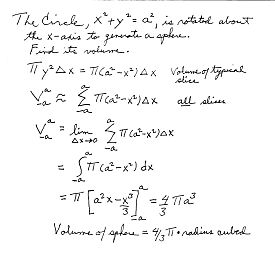
A Leap Of Faith The answer to both questions is the same. With calculus, one must first delineate a representative unit, then sum an infinite number of those between the limits set forth. Say what? Sum an infinite number of them? Yes. Our circle has only one dimension, remember. It has zero thickness. Placing one next to the other all along the length of our can will get us nowhere. We need another dimension, a circlular band cut from the can. To do that so that each band is identical, we first must decide on a gauge; an extension along the length-line that can be normalized as one unit. In that case, each circle has a thickness equal to one over the length of the can [1/lg.], and the surface area of a single one (they're all the same) is the circumference times that thickness, our gauge of 1/lg.. And how many of these circles are there? Well, there can only be the number length; the total sum of each circle's thickness must add up to one. With calculus, what we do is sum all those circles while gradually decreasing the thickness we've arbitrarily chosen, let it grow ever smaller, until, puff, it's gone--zero. We take a circle, and remaining in the world of the finite, keep making it thinner and thinner. We take the limit, in other words, as the thickness approaches zero. We make a leap. It's as though, at the very last, when the thickness has entered the quantum realm, we pull the rug out from beneath finiteness, and before infinity can notice, we've integrated. It's kind of exhilarating. Like quantum mechanics, it's right because it works in the real world. Leaping across chasms of discontinuities, non-differentiable holes in space, impossible to metricize, only topologically viable is what applied mathematics is all about. But without quantification--the result of measurement--nothing can be predicted, you say. I might point out that the spectacular bull's-eye landing of the rover Curiosity recently was the result of the brilliant work done by talented engineers, scientists, mathematicians, and programmers, among others. They hit the nail on the head, after traveling some 50 million miles, through evershifting gravity-well fields, while everything was in relative motion, moving and turning and changing position. Yet, it landed with precision in the crater they wanted. The mathematics, the celestial navigation, that went into that feat was ultimately based on an imaginary summation of circles with zero thickness. Once the summation is intiated, the process continues within no-time, and the thickness of our circles is reduced continuously. What's being taken to the limit as delta x (thickness of circle) approaches zero (is reduced) are the separate circles. In the process of adding more and more circles, the thickness decreases. Both processes go on simultaneously, until we make the jump from a very large number to a union of all the circles into a single integrated whole. They're smeared into one piece. The One has engulfed the Many. It's like shifting from algebra to topology at some critical point. In Topology, continuity is ascertained by a degree of closeness. Within that closeness--that Planck length--two blend into one, are identified as one. The total mass of the sun, considered as a continuum of shells, like an onion, equals the sum of the separate shell masses, no gaps allowed. It's pure magic, nothing less. We take it on faith.
***************************** Here's a preposterous idea: God as self-organization. Suppose the principle and process of self-organization were the Logos and Eros of God. Suppose the patterns, the forms, the natural laws, the open-ended evolutionary miracles were all products of God as self-organization--an internal, inherent superforce, regulating and overseeing all manifestation on every scale seen and unseen. And suppose the cosmos in its entirety was conscious. Spontaneous symmetry-breaking forever prodding complacent symmetry to change; hence, forces. By nature, predisposed to crescendo to a peak of criticality--on the edge of chaos--only to suddenly and unpredictably transform at the slightest nudge, the tiniest imperceptible touch, like an avalanche or an earthquake or a soap bubble or a life. And then to build again, the whole process repeated over and over, endlessly, regulated and orchestrated by God. Just suppose.
"... though free to think and to act - we are held together like the stars - in firmament with ties inseparable - these ties cannot be seen but we can feel them - each of us is only part of a whole." "We are a way for the cosmos to know itself."
***************************** The Deep As far back as the twenty-first century it was suspected that space and time were simply emergent phenomena of a more complex underlying process, like the earth's crust floating on its mantle. And three decades ago, that layer revealed itself by accident during a routine Higgs collision experiment at the Massive Heavy Boson Collider (MHBC) at Huineng, China. Due to an aberrant fluctuation affecting the normal phase shifting of entangled parameters, exotic tachyon particles interacting with heavy neutrinos, post-collision, produced an unheard of form of energy not predicted by causal string-field theory, that is to say, the equations don't allow for its possibility. The experiments were repeated with the dials set at the same positions, but with only occasional successes. Apparently, the interdependence and degree of complexity of calcuable variables are sensitive to factors of which we are not yet aware. Nonetheless, a window had opened onto a homogeneous immaterial realm previously unimagined.
 Indeed, another level lay beneath that of the quantum, a reality where the notions of particles and waves, fields and forces, were meaningless, having their existence confined to space and time. It was a reality of formlessness where vague apparitions of form seemed to appear, as patterns sometimes do in the clouds. Current understanding is that the tension involved creates space, which, in turn, by virtue of its inherent property of motion, generates time. It was the substance of emptiness, the texture of nothingness, the weave of a void within a void. Since its discovery, form and action have been recast as pure, non-specific mathematical entities at the basis of this 'Mind Energy.' That, pretty much, brings us up to the present--2206. This mysterious nether world was dubbed Mind Energy by the media; it fell into the same category as Big Bang, Black Hole, and Cosmic Fabric. Scientists working in the field thought of it in varying ways, from 'the great abyss' to 'string soup' to 'Pluto's basement.' But the most apt consolidation presently in vogue, compliments of Professor Herman Melville, is 'potential well of pre-archetypical generative cognition functors.' In casual discussions, however, it's referred to simply as The Deep. For the past twenty years Doctor Melville has led a team exploring the possibilities of using the Deep as an ocean on which to traverse the universe. They've been ensconced in a warren of labs under Mount Hood, not so much for the shielding from potentially disruptive influences--cosmic and gamma rays--but rather for the isolation from the distractions of society. Basic questions had to be answered. What's the nature of the Deep? Does it possess physical properties, properties like those we're used to in the real world? What IS the real world? Is the Deep devoid of any kind of metrizable landmarks, and if so, how do we navigate, how do we determine where we are? It was realized early that the ordinary questions asked of ordinary space would probably not be worth pursuing. New unimagined processes--if so there were--needed new unimagined questions. The investigating team had to put themselves into a totally different headspace, one more conducive to understanding this vast sea of potential. The Deep has no underpinnings or cause; it was not produced or emergent or fabricated. It exists, but only in the sense that we humans are aware of it. Those with a more philosophical bent thought of it as the Unconscious, a boundless expanse wherein chaotic raw psychic material dwelled, waiting for the consciousness of all living things to use it, give it order, purpose, manifestation. In the scientific community it was seen as the source of creativity, whatever that may mean in the framework of scientific endeavor. As no structure or forces were perceivable, the question of dimension had no significance. However, beyond considerations as to its nature and import, the practical question took precedence: Was it something that could be traveled through, in some sense akin to traveling through ordinary spacetime? When we move through ordinary space, we also move through the quantum realm, they interpenetrate and support mutually. One gives life to the other, symbiotically. But, is Mind Energy also immersed and inseparable? Is it one with the others throughout? How else could we know of it if it was not somehow connected? The cognition functor mapping topological spaces and continuous maps to linear spaces and transformations represented the action of creation. That much was understood in the abstract. But unless a metric could be imposed on this amorphous nothingness, nobody was going anywhere. It was a thursday, six months ago, sitting on a bench in the light drizzle, in the garden outside the Mount Hood facility, deep in thought, careless of the weather, when Doctor Melville saw what needed to be done. Later that afternoon he called a meeting of his team. It was time to push what they'd accomplished thus far to the next step. He asked for volunteers, but only from those who were single; the danger was undeniable and unforeseeable, as are most ventures into the unknown. Over the years of research they released news items to the public, not so much to keep them informed--God knows most people are preoccupied with their own lives and couldn't care less--but to keep the budget for the project flowing. However, what they revealed was only of superficial importance, mere general descriptions based on comparisons between the known universe and the Deep. Their more significant breakthroughs they kept to themselves. This policy served to thicken the bond among them, they became a family, sharing thoughts and attitudes at daily meetings where they'd sit in the central conference room holding hands in a circle, feeling and knowing the oneness of mind. This practice wasn't just intended to solidify the group allegiance to the mission, but had been deduced to be a necessity in order to resonate with the Deep. This practice engendered a cross-product of individual minds blurring the distinctions between them, fostering one whole complex interwoven mind, a group mind having at its central focus a single purpose. Nothing of spacetime could transit the barrier separating their corporeal being from the Deep. It was of an entirely different nature. Their major discovery was what they called the Hawking Field in honor of the physicist Stephen Hawking, who, in the early 21st century, unraveled the mystery of Time. Sentient minds had been found to possess this field which could be accessed under certain specific circumstances. It allowed people to enter the realm of timelessness, the space of the psyche. Extensive experimentation proved that the only means by which a living being could enter the Deep was by becoming pure thought. Based on the hypothesis that Mind permeated physical being--matter--they learned that organic material was able to project this mysterious and previously unimagined field, a field that, once activated, reoriented corporeality to correspond to the nature and identifying matrix of pure thought. It had been there all the time. At the onset of the project, the idea was to construct ships capable of traveling through the Deep, ostensibly to appear at a preassigned designated point under, so to speak, the known universe, and then to poke through to the surface of spacetime. But all such naive notions were drawn from conventional ways of perceiving reality and were scrapped early on. The Deep had no such restrictions or requisites or capabilities. Once inside the Deep, they surmised, travel itself would be meaningless, as meaningless as traveling in dreamland. So, the original motivation for the project--to use the Deep as a medium of physical transit through the universe--was abandoned. However, no one outside the group knew this. Everyone volunteered, eagerly, for the assignment, dangerous as it was. But Doctor Melville accepted applicants based on a criterion he'd devised. First of all, they had to be single, no attachments whatsoever, not even strong friendships outside the group. He felt this would be a distraction to the intense focus demanded. Their psychologial and emotional profiles were even more important. Three of the volunteers possessed a singlemindedness bordering on obsession he required, and emotionally were empathetic to the point of an incapacity to assert their own desires above those of their fellows. In the social world, these two traits made for a dysfunctional person, but here and now, it presented the optimal configuration. Two men and one woman, names withheld, at least for now, were chosen. The rest, however, would not idly stand by. They would have to act as psychic support, bonding together during the procedure, amplifying their collective mind energy, directing it towards their teammates. The clean room was just that, no organics existed, removed by ultraviolet light and resonating sound waves of a frequency disallowing for growth. The surfaces of the walls, floor, and ceiling were of a carbon-free material long-known to resist oxidation or corruption of any kind. It gleamed, producing disorientation when walking through, as though immersed in liquid. Once confined in their suits to the body-conforming chairs, securely anchored to the floor, the gravitational field would be nullified, and every molecule of air pumped from the room. As much as possible, no traces of ordinary spacetime were permitted to interfere with the procedure. The three stayed in the purifying room that night, consuming only those nutrients found to foster acute mental intensity, physical well-being, and emotional stability. Nothing that might offset their perfect physical condition--the third and final requirement of Doctor Melville--was allowed to enter their bodies. The following morning they donned their suits. These were not the familiar astronaut suits with which everyone is familiar, they were not going into ordinary space, but rather consisted of a fabric extruded through rotating spinnerets set into the walls and ceiling of the suit room. However, it was not a liquid-like material, but rather more closely resembled the quality of an inert plastic-metal alloy, a material so light weight and impervious to cracking as to seem more like skin than something worn. It immediately conformed to their body shape and was elastic, stretching and contorting as though alive, and, infused as it was with an organically generated Hawking field, possessed the capacity for rudimentary awareness. After the merger, the separate components became indistinguishable, having crystalized into a single uniform material. A synthesis so completely interpenetrating that the resulting thought-sensitive feature, compliments of the genetically altered organics, automatically tuned the suit to sympathetically resonate with the distinct subject it enwrapped. Conseqeuntly, a feedback loop was established, enhancing and reinforcung the wearers own mental signals. A helmet of one piece, devoid of the usual openings for eyes, nose, mouth, and ears--these would not be necessary--composed of solidified argon-36 covered the head snugly, but without any sense of tightness that might induce claustrophobia or discomfort. Breathable air was unnecessary, the three would consume a sufficient amount of time-released air-producing pellets, long ago developed for astronauts. At the center of the clean room sat three high-backed wraparound chairs arranged in a circle. Except for the cameras embedded in the walls and ceiling and one speaker near the door, the room was empty. The three volunteers were escorted into the room through a door that connected to the suit room, itself as clean as possible. After making themselves comfortable, they put their helmets on and were strapped in, just in case. Their colleagues wished them luck, then retired to the monitoring area. In due time, the three were asked if they were ready. As one, they replied in the affirmative. A countdown began from ten. At five, the gravitational field in the room was neutralized, thus completing the experience of sensory deprivation. At zero, the Hawking field kicked in, emanating from the enveloping chairs. Immediately, their internal Hawking field, reinforced by the suits, effectively suspended their material existence. That is to say, it was lost to them as though never having been, leaving them cast adrift in a sea of pure thought. Initially, all moorings with the world of sense and feeling bewildered them completely, the threat of panic tempting at the periphery of consciousness. But their training had been intense. In the surrounding darkness, they found one another's thoughts, and through the mingling of minds, formed an identity of purpose. This was their first discovery in the nether realm of the Deep: They could control a joint sense of self through sheer will power. Will, thus, had to be of the nature of the Deep. Thoughts meandered, images appeared: a jellyfish floating free in the ocean, an asteroid tumbling through space, a leaf caught in a stream. All were being drawn in one direction. Shapes began to appear in the bleak empty darkness. Pieces of barely perceptible impressions spread out around them over the entire voluminous mindscape. At first they were dim, then, as other more complex patterns emerged from the void further on or suddenly appeared seemingly in the background, the unclear, disjointed ones began to stretch and extend like tendrils of ivy, finding one another, touching, then smoothly fusing together. Eventually, they joined completely as one convoluted interlaced whole, fingerpaints of light, almost blocking out the complex figures beyond. Abruptly, or so it seemed, the complex designs spliced themselves into the interwoven sphere as though they'd always been there, lifting the entirety to a tangled intricacy that was painful to behold. The unimaginably bizarre arrangement, too involved to ever separate into basic units, continued to grow in complexity as though a colony of microbes in a petri dish, enveloping the three deepnauts in a sphere of interconnected imagery, a tapestry of twisted thought. Inside this cathedral of geometric madness, they willed themselves to think. One suggested the bubble had always been there, it was they who were adapting to the Deep; they should, therefore, expect other apparitions and novel features. As though on cue, a tingling sensation vibrated through their one mind, followed by others of a more dramatic character. They were being contacted, touched, by other beings who also were immersed in the Deep. Aliens, groups of them, attempting to communicate by means of changes to the surrounding unfinished globe, now seen as a community medium of expression. They knew this by a means unknown, but openmindedness was the catchword for this expedition, literally and figuratively; all usual expectations and assumptions had been left at the gate. The logic of classical macro-spacetime ran into trouble when quantum mechanics came on the scene. Likewise, this new realm had a logic of its own, if indeed, it had any at all. The tentative mingling subtly changed to an integrated mixture; distinctions were yet noticed, however, and clearly defined. But that was not to last. As they watched, fascinated, the separate identity of their threesome passed a barrier of recognition. The inner sphere no longer expressed the thoughts of the members of this vast ad hoc community of alien minds, with each type uniquely isolated, as though each had a team-color designation, but rather it morphed, blended, unified until all dividing lines lost meaning and significance. They found this shift in perspective alarming. A sense of self, at least for humans, necessitated an equally definite sense of other. But that had dissolved away like snowflakes in the sun. However, the loss of a sense of separateness was quickly compensated for not only by an all-abiding intellectual feeling of peace and security, but also by an exponential increase in the sense of size. They, that is to say, they/others made another discovery: Each set of aliens in the galaxy--to be sure, they felt confined to galaxy--represented a perspective unique to a type of sentient and an aspect of universal reality, and their corresponding images depicted their mind essence. On the heels of that, a thought projected the image of a fan of different colors of tree wood spanning the spectrum from the lightest pine or aspen to the darkest teak or mahogony. Of its own, the question formed and was immediately speculated upon by the group: Even though separated by untraversable distances in spacetime, perhaps the sentient population of the universe was of one mind, here, in the Deep, jointly interacting, sharing, collaborating. As though in response, the globe around them pushed further away, expanding to include more alien embeddings and configurations, the images of which transformed quickly, changing as though melting to form new elaborate patterns here and there, contributions to the whole, thoughts asking and answering, never remaining fixed for long. The three deepnauts shared the exhilaration and the communion. Asking questions formerly unimagined, somehow easily comprehending answers to mysteries never before recognized as such by humans, their minds free from the constraints of knowledge acquired in the ordinary world, the frame of predisposition erased. At the start, they were limited by the prism of humankind--the human universe--but now they were liberated, now they were joined with other alien minds to gain an all-encompassing communal perspective and see a larger truth, a mosaic of truths, a more complex structure describing the inner workings of the universe and what lay beneath its manifestation. If they were still in touch with their bodies, they would have cried with sheer joy at the grandeur and beauty of it all, the unbelievable vista, the everchanging sphere of thought-images before and around them. In the midst of this revery and mutual exchange of knowledge, this celebration of discovery and revelation, it all suddenly vanished like so much gossamer webbing caught in a fire. The lights had come on and they heard voices. Their first sensation was the weight of their own bodies, strangely unfamiliar. Initially unintelligible garblings and mutters gradually changed bit by bit to words they understood. Their helmets were removed and the restraining straps undone. Their colleagues surrounded them, smiling and offering congratulations and warm feelings of gratitude for their apparent well-being. Somewhat shaky on their feet, the three were escorted to the suit room. Perplexed, still joined as one mind, they were unable to speak, to form words of their own. Gradually, as their suits were removed, their individuality returned, accompanied by a deep sadness welling up. The woman cried, and although the men appeared stoic, they too were obviously suffering the intense emotion of separation. After a thorough medical exam, they were given food and drink. Withdrawn and still quiet, the others wondered if they had experienced some serious psychological or emotional damage. Anything could've happened, that had been the danger. Pensive, they ate in silence, savoring each morsel and sipping water as though their sense of taste was a newfound pleasure. Afterwards, they were allowed to sleep; the debriefing could wait. Under the watchful eyes of the doctor and a few of their closest teammates, they slept in the infirmary. They'd been given a mild sedative, so in no time, fell into a deep slumber. In Dreamland they found one another on a white-sand beach, waves gently rolling in, soundlessly. The sun, barely over the horizon, shone through wispy, wind-streaked clouds; cotton-ball islands of saffron, lavender, bright pink, and the palest yellow. The woman stood between the men; looking out to the endless blue-green sea, they held hands, saying nothing. The crisp morning air smelled of briny life; the sand was damp yet soft under their bare feet; the lapping of the waves intensified. As the sun rose, diamond-sharp specks of light sparkled and danced across the calm sea like fireflies flickering on a summer's eve. Gradually, the scene composed itself; the elements of its creation filled in and overlapped, blended and harmonized, like an orchestra warming up for the big show. As though on cue, continuing to hold hands, together they walked into the sea; the sound of the waves rose and fell; the sun, now past the clouds, warmed their skin; the cool water enveloped them, its touch tingling and invigorating. When they were almost submerged, they took one long look at one another, smiled lovingly, then stepped beneath the surface. The following morning's debriefing didn't go so well. It was like trying to remember a dream. Once again in their normal everyday consciousness, their experience was impossible to translate. All they could recollect with certainty was the overwhelming sense of wholeness and oneness with the universe, and that, as hoped, they were able to keep in mutual contact. Losing physical sensations was expected. Beyond that, it was a blur of outrageous, incomprehensible sights and stray images. Not much more of any note. What was the Deep? They couldn't define it or properly--scientifically--characterize its nature, except for words like nebulous, vast, non-dimensional. All they knew for sure, and it was unanimous, was that they had to go back. Had to.
*****************************
Sambo, on a quiet summer afternoon ***************************** Hubcap on the side of the road, Leaning back against the tall grass, Dented and worn;
How many miles has it seen?
Hubcap by the side of the road,
***************************** I went to ANCESTRY.COM and discovered that my great, great, great, great, great, great grandmother was a lemur from Madagascar. How incredible! Madagascar. I wonder if I still have relatives there?
***************************** September 28, 2012Today is my birthday. I have to keep reminding myself because I haven't paid much attention to it over the years. I remember one year I was writing a check and when I wrote the date realized it was my birthday. So I don't get all that pumped up about it. Nonetheless, I feel the need to say something as this might be my last birthday. I'm tempted to write some self-pitying stuff about how my life has turned out, dwelling on the missed opportunities, screw-ups, and other such depressing worthless crap. But I've never cared for people who waste their time feeling sorry for themselves over spilled milk, people who see themselves as victims, people who use it as an excuse to adopt an angry attitude towards the world or certain kinds of others. So, I won't do that. What's the point, all that whining, crying, bitching, and moaning like some self-absorbed 12 year old. Looking back, I've had some really good years, some excellent, adventurous, exciting years. I could've spent my adult life working in some cubicle, or, if lucky, engaged in projects that were exhilarating and meaningful. But what I did early on, instead, was to run away from all those possibilities. I headed out, following my nose, sniffing for the unusual and bizarre. I wanted to be on the edge. All the criteria I came up with to guide my way--religious, philosophical, psychological--proved to be insufficient and regulatory. From the outside in. Now, I see a different way. From the inside out. The X-factor. Outside the limitations set down that created the illusion of security and self-protection. A way that doesn't need to reference some code to check if I'm on the right track or not. Paranoia runs deep and acts to short-circuit all attempts at self-realization and assertion. Let me be general here. We develop a code to get around our basic fear, a criterion that primarily promotes the illusion of freedom, of living according to the truth of how life is intended to be lived. As years go by, contradictions mount up, eroding confidence in the code, whatever cobbled-together form it's taken. And, if we are caring of others to begin with, by nature, underneath it all, we will be conflicted as well, trying to hold back and go forth at the same time, fearlessly. A double-bind like that only serves to undermine and to set us up for failure. We keep striving for control while important and meaningful relationships slip through our fingers. Catalyzed by a final straw of some kind, a heart-breaking event perhaps, one that is perceived as being caused by us, directly or indirectly, we implode. All faith in the code, now threadbare and riddled with holes and tears, unravels and is blown away by the winds of change. We are left alone amidst a wasteland. This collapse is accompanied by a torrent of anger and rage. It's paramount that this intense and potentially violent emotional state be controlled and channeled coherently towards a resolution combining will and mind and heart. The ego that was riding this wave of certainty as well dissolves and loses its strength. We see clearly that we had been afraid all this time, hiding deep within is the person we were meant to be, the person we turned our back on and submerged beneath a thick crust of rules and consciousness of another world, a world wherein we are able to understand the nature of external life, objectifying how people think, their mind-sets separated and excluded from the physical and emotional domain, that which gives it context. Free to live therein, but not free to be who we are. Post collapse, we see the inverse of our previous perception. We face the ultimate fear that drove us to concoct or adopt such an incredibly elaborate complex of beliefs whose intention was to escape and defeat the fear. It did so, but only at the cost of losing that which was deeply meaningful in our lives, that which gave it purpose and ourselves an unsupported independence and true freedom. We can't reject relationship itself and at the same time use the rage that spawned it to produce a sense of freedom. We are then only free to be self-centered and arrogant. After all, we know the way, they don't, and it's up to us to teach by example. Once the putrid mess blows away and nothing remains to prop up our selfish will, nothing left to engender the illusion of certainty and freedom, we have a chance to start at the beginning, for however much longer we have to live. The X-factor is our love for who we love and for what we care about and our will to stand-up for it whenever the occasion necessitates. Ultimately, we need to abandon our rage and anger at the imagined cause of our fear and allow the natural state of relationship with nature and others and life itself to take hold. Surprisingly, once we commit to this state of mind, strength and energy flow in as though the walls once holding back the nurturing waters have crumbled. That's the surety which needs no criterion to bolster its truth, and it takes a different mode of courage than that required to confront and challenge the external physical world. It's right there in front of our face, and always has been, waiting.
"To thine own self be true, and it must follow, as the night the day, thou canst not then be false to any man." "What a man thinks of himself, that is which determines, or indicates, his fate." "If a man does not keep pace with his companions, perhaps it is because he hears a different drummer." Henry David Thoreau: Biography, etcetera
*****************************
***************************** 
***************************** |
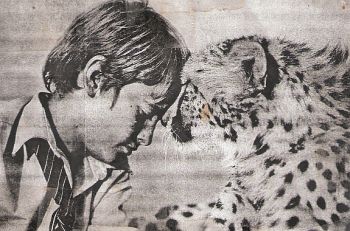
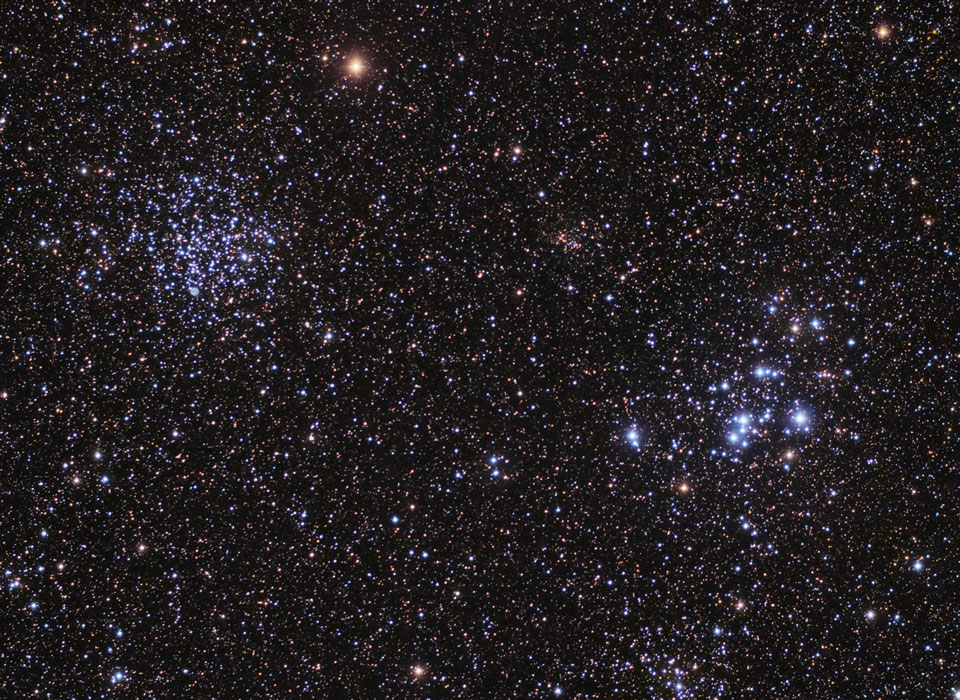

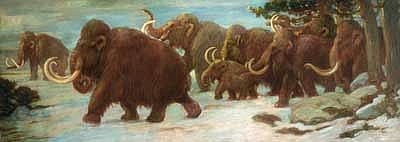
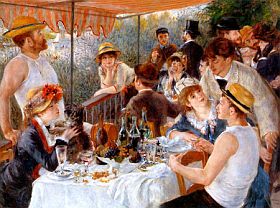
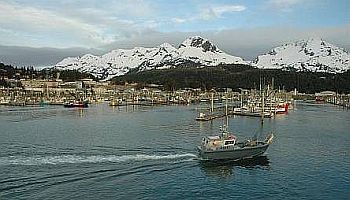
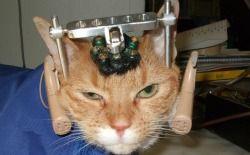
 Believing in self isn't important; at least, not as important as seeing reality. Not daring to do anything or even think outside the lines--restrictions that exist soley in one's head--yet trying to perpetuate and project the image of a free spirit can lead only to doubt, confusion, and chaos. You can go out to sea and be totally open and fearless, competent and confident, yet not be able to assert the meaning of your life, the intangibles; ready and willing to go to any degree to protect that which is irreplaceable.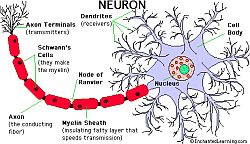
 It's obviously a cult starting in our midst. A cult that worships clarity as a way in to our psyche in order to manipulate, exploit, and impose social engineering and behavior modification. Once you've opened up to these mind-control fanatics, plasticity will become a by-word, an excuse to believe that whatever we think is just as good as anything else. It's all just neuroplasticity, we'll think, a fluidity, redefining the engram formed by a few neurons and their millions of connections, generating and emphasizing some while supressing and removing others. Then, who's to say. We end up remembering everything that happens in vivid detail, use faculties we forgot we had, process information like nobody's business, and yet not know why we're doing what we're doing.
 Those faded engrams that constitute the substrate of my previous personality are reemerging, are being awakened, so to speak. Every so often, unbidden, I'll recall a positive experience in my past that causes me to stop short. I think to myself: Did I do that? Was I once capable of such confidence and strength of will, such openness to dangerous circumstances? It's like remembering someone else, another person entirely, another person I came to know and be, usually accompanied by the thought: Had he been present all along, that avoidable event would probably not have occurred.
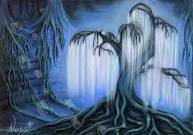
 Drizzle smeared the side window of his tiny trailer, the chill grey numbed his spirit and drove his will underground. Lying still, on his right side, he peered through the window to the the trees beyond, seeing yesterdays stretched back in time. Early spring, dusk was beginning to settle. As he stared mindlessly, aware only of his body and the rain beyond, a shadow, higher than his roof, passed by. Long and lean, colorless against the silent background, it vanished. He froze, unable to move or even breathe. Paralyzed as when a child and someone had broken into the apartment, he lay in bed, still as death.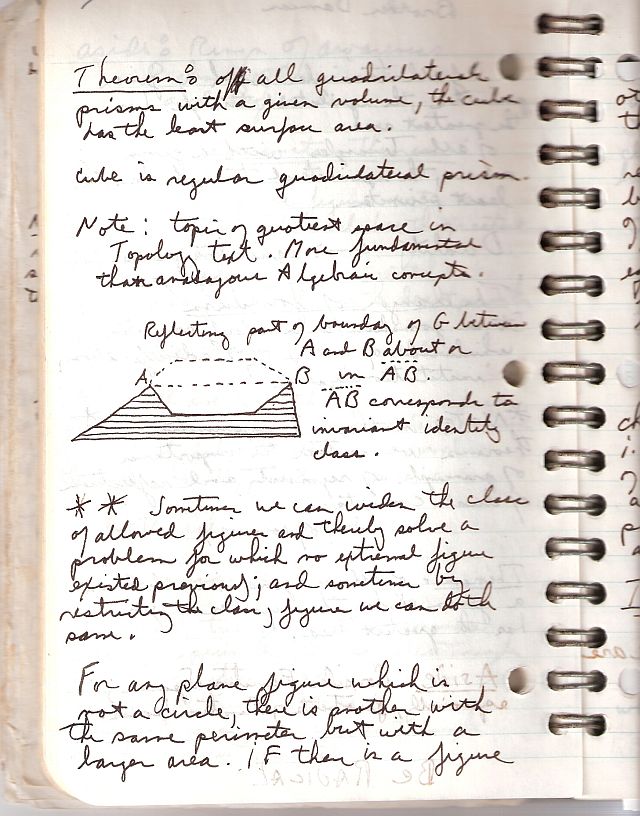
 Doctor Oscar Gablinski, of the Munich Polytechnic Institute, and his team have recently discovered that thought affects the familiar material plane in a manner, and from an oblique dimension, previously unanticipated or imagined. That is to say, the brain's biochemical activity in the form of cogent coherent engrams is not only capable of generating four-dimensional phenomena in ordinary five-percent matter, but also is directly connected on multiple channels at once to the fabric of spacetime. As the stationary ether was once believed to exist, it had always been accepted that an intervening medium was necessary for thought-manifestation, but now Doctor Gablinski has shown that thought is everywhere; in fact, it is the medium. In other words, without thought, there would be no spacetime.
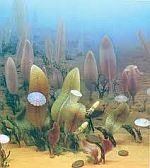 Long, long ago, here, on planet Earth, completely alien life-forms thrived and lived according to a very different yet workable paradigm. The Ediacaran fauna, predating the Cambrian explosion of approximately 550 million years ago, represent the first multicellular life. Their lifestyle was idyllic, placid, serene, to be understated. The majority of these creatures were anchored to the sea floor, fronds swaying in the currents. A day in the life consisted of passively feeding on, or absorbing, nutrients drifting by, tiny phytoplankton or detritus of dead things. It was a way of living pervading all creatures on the face of the Earth, which is to say, under the sea.
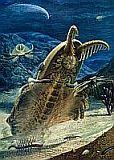 What are the prominent characteristics of the icons of the current predatoy world? The lion, the eagle, the killer whale, the great white shark? Aggression, ferocity, ruthlessness, stealth, to be sure, but also courage, steadfastness, and cunning mark their natures. A wolf pack works together to bring down prey as do humpback whales to round up herring. They've devised strategies and teach them to their young. That's how it is now--cooperation, competition, conflict--but once upon a time it was a very different scene indeed. What happened to cause such a radical shift? All over the world? Something clicked, evolution itself altered drastically and has never returned to the former way. It learned new tricks, new ways to modify, to process, to achieve advantage and by so doing increase the complexity of nonlinear relationships exponentially and to accelerate expansively. Previously nonexistent metabolic pathways and morphogenetic fields opened up seemingly out of thin air. Evolution abandoned the old way like an adolescent casting off his braces--time to grow up and move on. Likewise, evolution has moved on; no attempt to regress has been made. But, would it constitute a true regression or just another style alongside the now one, of equal status in time and place?
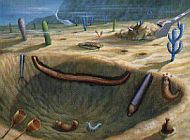 We are in Phase Three. The first 3 billion years was the Microbial Period--Phase One. After that we have the Ediacaran--Phase Two. Now, we're in the Cambrian Explosion Era--the Big Bang of Biology. The quintessence of each phase finds its manifestation in the method describing the way of life of the resident creatures. The organisms existing--coming into being, evolving, dying out--during each phase are but an expression of this way, embodying it thoroughly, infused as it is into every cell of their being.